The XR-1 VLA Breakthrough: How Embodied AI is Revolutionizing Industrial Robots (And How AI Founders Can Cash In)
The Multi-Billion Yuan Headache That Legacy Industrial Robots Couldn’t Fix
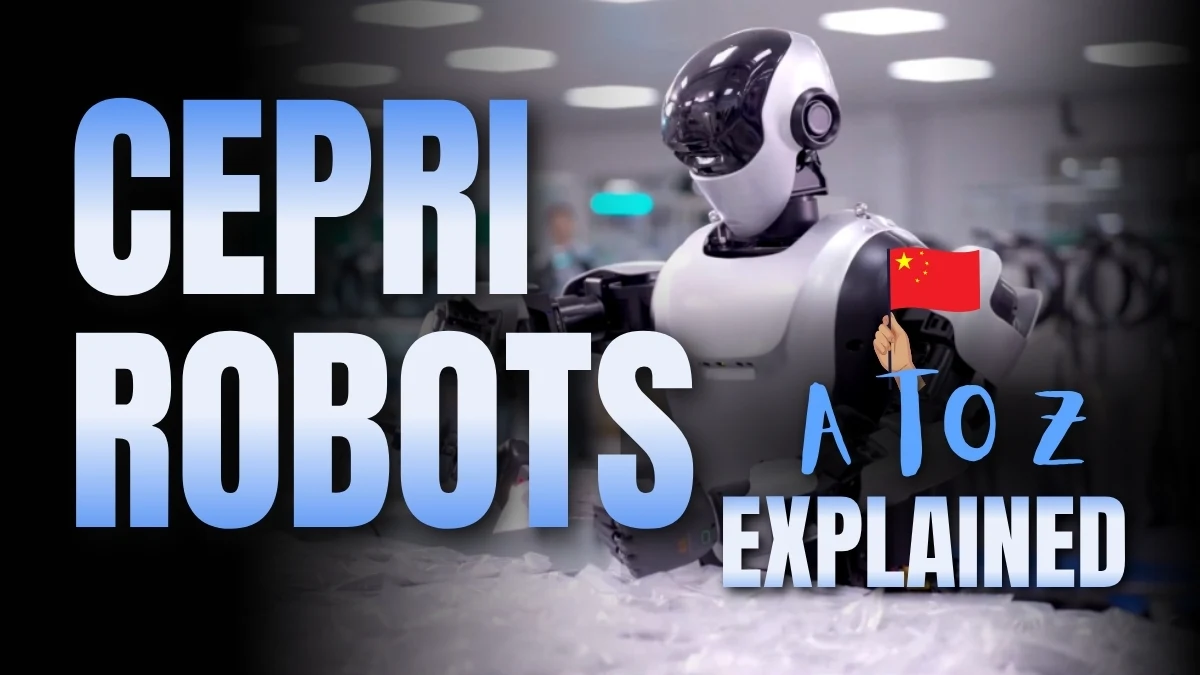
CEPRI Robots? For years, the heavy industry and power grid sectors have tried to solve their inspection and manual labor problems by throwing industrial robots at them like expensive, metallic confetti. And for years, those robots have been about as adaptable as a screen door on a submarine.
Table of Contents
Legacy industrial robots—the kind you still see in most substations—religiously followed preset paths. They suffered existential breakdowns when a stray branch, a slightly moved coffee cup, or a change in lighting appeared in their field of vision. They basically needed human babysitters to hold their cold, metal hands through every minor environmental variation, leading to a “human-to-robot ratio” that made automation more expensive than just hiring a team of interns with flashlights.
Then the embodied AI paradigm shifted.
The Beijing Humanoid Robot Innovation Center (BHRIC) got tired of the status quo and unleashed what actually makes humanoid robots work: the XR-1 Vision-Language-Action (VLA) model. We are no longer talking about glorified Roombas. We are talking about embodied AI systems that use Unified Vision-Motion Codes (UVMC) to “instinctively” react to their environment. Whether it’s stopping a pour if a container slides or navigating a door that’s sticking on its hinges, embodied AI is finally moving out of the lab and into the real world.
This isn’t CGI magic or a venture capital fever dream. This is a massive market shift in industrial robotics. If you’re an AI founder, grab a notepad. This guide walks through the actual embodied AI tech that works, the massive piles of cash on the table, and exactly how you can piggyback on this open-source ecosystem.
Why the XR-1 VLA Model Makes Legacy Industrial Robots Obsolete
The bottleneck for industrial robots was never the hardware; it was the “brain-cerebellum” connection. Previous attempts at automation failed because industrial robots couldn’t translate high-dimensional visual data into precise motor controls without a massive computational “lag” or total system panic.
Enter the XR-1 VLA Model, a unified framework that fundamentally breaks the perception-action barrier in embodied AI. Unlike previous models that treated “seeing” and “moving” as two separate software modules, the XR-1 VLA Model introduces a dual-branch VQ-VAE that jointly encodes visual dynamics and robotic motion into a single discrete latent space.
The UVMC Secret Sauce in Embodied AI
The core innovation of the Beijing Humanoid Robot Innovation Center is the Unified Vision-Motion Code (UVMC). In plain English? The embodied AI isn’t just looking at an image and “guessing” what to do next. It uses a shared “codebook” where visual patterns (like a door handle turning) are mathematically linked to motion patterns (the torque required to pull). This alignment allows the XR-1 VLA Model to perform “zero-shot” adjustments. If the door is heavier than expected, the UVMC feedback loop detects the discrepancy in the motion code and adjusts the force in real-time, exactly like a human would.
In rigorous real-world testing, the XR-1 VLA Model was put through over 14,000 rollouts across six different robot embodiments, mastering more than 120 diverse manipulation tasks. In the world of embodied AI, it didn’t just compete; it actively outperformed state-of-the-art baselines like $\pi_0$ and NVIDIA’s GR00T-N1.5. It proved it can handle dexterous, contact-rich tasks—like threading a needle or sorting vibrating industrial parts—where legacy industrial robots would have failed.
From Lab to Factory Floor: TienKung Humanoid Robots in the Wild
We aren’t just talking about lab metrics and GitHub stars. The “cerebellum” of these embodied AI systems is already hitting the factory floor in one of the world’s most demanding environments.
As of late 2025, the Beijing Humanoid Robot Innovation Center deployed their TienKung 2.0 and Tianyi 2.0 humanoid robots at the Foton Cummins engine factory. Operating on a fully unmanned production line, these industrial robots autonomously handle material bin fetching, sorting, and transportation.
What “Autonomous Embodied AI” Actually Looks Like:
- Dynamic Adaptation: These humanoid robots adapt to varying goods and shelf heights on the fly. If a bin is placed 5 inches to the left of its usual spot, the embodied AI doesn’t throw an error; it just reaches 5 inches to the left.
- Multi-Agent Collaboration: Through the “HuiSiKaiWu” platform, multiple TienKung units coordinate their movements to ensure the production line never bottlenecks, sharing a single “cloud brain” while maintaining independent “local cerebellums.”
- Reliability Metrics: Early reports from the Foton Cummins deployment suggest a significant jump in stability, with embodied AI handling high-risk, repetitive tasks that previously saw a 15% human error rate due to fatigue.
For high-risk environments like power grid substations, the implications of embodied AI are massive. We are moving toward a “deploy and forget” model where an autonomous agent can visually assess a damaged insulator, grab the correct replacement tool, and execute the repair without a human joystick in sight.
The Embodied AI Market Opportunity: Real Numbers for Startups
If you are thinking about pivoting your AI startup into the embodied AI or industrial robotics space, the math is aggressively in your favor. The “Virtual Economy” (pure SaaS) is becoming saturated; the “Real Economy” (embodied AI in the physical world) is wide open.
China has made embodied AI a critical national priority, aiming for mass production of humanoid robots by 2025 and global market dominance by 2027. In just the first half of 2025, capital poured over 20 billion yuan (approx. $2.7 billion USD) into the embodied AI sector, sparking more than 130 separate financing events.
The Rise of DaaS (Data-as-a-Service) in Industrial Robotics
A new business model is emerging: Data-as-a-Service. Because high-quality, real-world training data is the primary bottleneck for embodied AI, companies like AGIBOT (which hit $140M in revenue in 2025) are now building “data factories.” These are facilities where humanoid robots run 24/7 to generate millions of interaction trajectories.
For a startup, the opportunity isn’t necessarily building the robot body—it’s building the specialized embodied AI “Skill Modules” or providing the curated datasets for niche industries like nuclear maintenance, deep-sea mining, or specialized electronics assembly.
How AI Startups Can Capitalize on the Open-Source XR-1 Ecosystem
Here is the alpha that most generic tech blogs skip. You do not need billions in venture capital or a basement full of PhDs to train a foundational embodied AI model from scratch. BHRIC has open-sourced the core components of their tech stack, giving scrappy founders a massive head start.
1. Raid the RoboMIND 2.0 Dataset
The hardest part of embodied AI is getting high-quality, physical interaction data. BHRIC just handed it to you. The RoboMIND 2.0 dataset is a goldmine. It offers over 310,000 dual-arm manipulation trajectories spanning 739 complex tasks. Crucially, it includes 12,000 tactile-enhanced sequences, allowing your embodied AI models to “feel” the pressure of a grip—a necessity for delicate industrial robots.
2. Fork the XR-1 Repository
Don’t reinvent the wheel. The actual XR-1 VLA Model is available on GitHub. It features a robust 3-stage training pipeline for embodied AI:
- Self-Supervised Learning: Learning basic UVMC codes from massive video libraries.
- Cross-Embodiment Pretraining: Injecting that knowledge into a VLM backbone.
- Task-Specific Post-training: Fine-tuning for your specific business case.You can fork this, inject your own niche data (e.g., “how to fix a specific Siemens transformer”), and have a viable AI product in months, not years.
3. Train in the “Sim-to-Real” Matrix with ArtVIP
Physical industrial robots break, and industrial downtime costs millions. By leveraging the ArtVIP dataset, founders can access high-fidelity digital twins. These aren’t just 3D models; they are “articulated assets” with precise physics—friction, damping, and joint limits are all pre-tuned. Blending this synthetic data with real-world trajectories has been shown to boost embodied AI task success rates by over 25%, effectively solving the “sim-to-real” gap.
The Founder’s Embodied AI Cheat Sheet
| The Resource | What You Actually Get | Where to Find It |
| XR-1 VLA Model | The core “brain” source code (VLA + UVMC) | GitHub: Open-X-Humanoid/XR-1 |
| RoboMIND 2.0 | 310,000+ trajectories + Tactile Data | ModelScope: RoboMIND2.0 |
| ArtVIP | High-fidelity digital twins for Isaac Sim | HuggingFace: ArtVIP |
| HuiSiKaiWu SDK | Tools for multi-agent industrial robotics | BHRIC Official Portal |
The Bottom Line: Industry 5.0 is Personal
The era of “dumb,” pre-scripted industrial robots is dead. We are entering the age of Industry 5.0, where human-machine collaboration is defined by embodied AI that understands the physical world.
The hardware is largely a solved problem—companies like Unitree and AGIBOT are already mass-producing humanoid robots at falling price points. The real value has migrated to the software stack. With the XR-1 VLA Model and the RoboMIND 2.0 ecosystem, the “operating system” for the physical world has been open-sourced.
Is it easy? Absolutely not. You’ll still face thermal management issues, battery life bottlenecks, and the “uncertainty” of messy factory floors. But for the first time in history, a small AI team can build a robot that doesn’t just move—it thinks. The best time to start building your embodied AI vertical was yesterday. The second best time is right now.