Shanghai Humanoid Robot Data Center: The 5,000㎡ Facility Where 100 Robots Learn 45 Skills in Complete Secrecy
Table of Contents
You have seen the videos. A humanoid robot folds a towel. Another stacks boxes. A third screws bolts into a refrigerator panel with millimeter precision. They move smoothly. They rarely fail. They look almost human.
What you have not seen is what happens before the cameras roll.
Behind an unmarked entrance in Shanghai’s Zhangjiang Science City, a 5,000‑square‑meter facility operates 24 hours a day, 365 days a year. Inside, 100 humanoid robots from 10 different manufacturers run the same drills over and over. They grasp, they lift, they place, they fail, they recalibrate. By the time a robot leaves this building, it has attempted a single motion up to 50,000 times.
This is the Shanghai Humanoid Robot Data Center. It is not a factory. It is not a lab. It is the largest robot training facility on the planet, and it is the reason Chinese humanoids are advancing faster than any other ecosystem.
For AI founders, robotics entrepreneurs, and anyone building the next generation of embodied intelligence, understanding what happens inside this facility is not optional. It is the difference between watching the revolution from outside or being part of it.
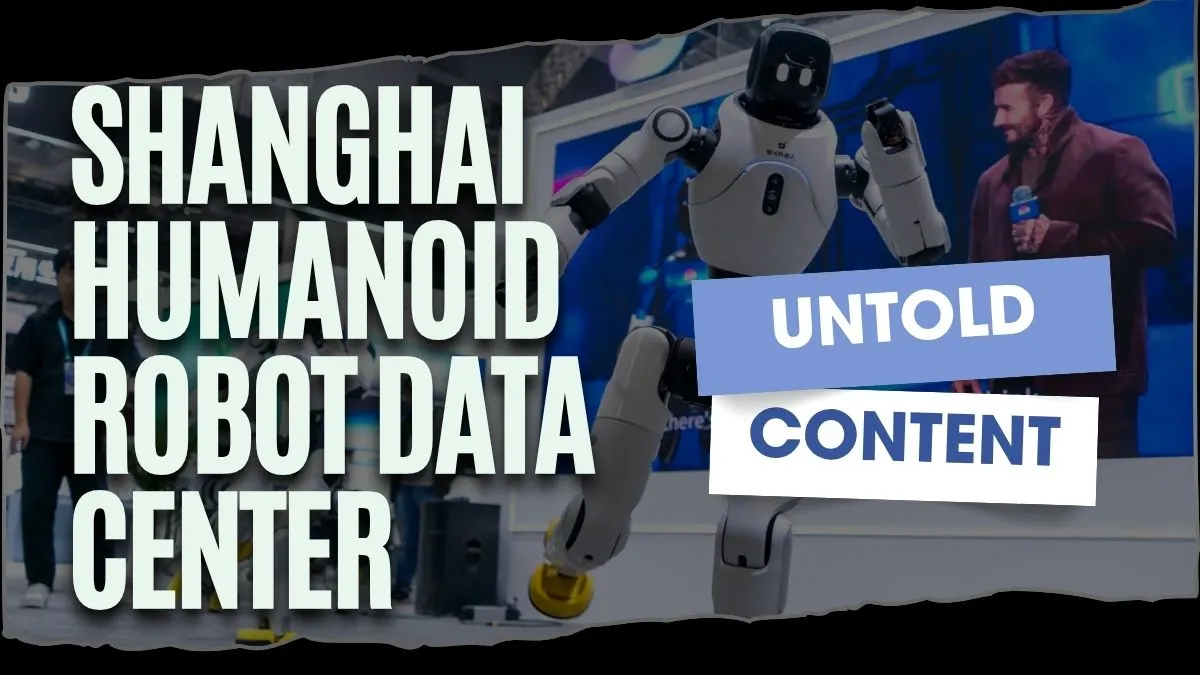
The 5,000㎡ Nerve Center Where Robots Go to Fail
What Is Shanghai Humanoid Robot Data Center? The $29 Million Answer
The Shanghai Humanoid Robot Data Center opened in early 2025 as a joint initiative of the National and Local Co‑built Humanoid Robotics Innovation Center and the Zhangjiang Group . The investment: 200 million yuan—approximately $29 million . The mission: to solve the single biggest bottleneck in embodied intelligence—data.
“We established the center to enable large‑scale data sharing and utilization, empowering the entire industry,” Xu Bin, general manager of the innovation center, told reporters .
The facility is designed to collect, process, and distribute training data for humanoid robots across multiple manufacturers. It occupies the Modu Space building in Zhangjiang, a district already home to over 100 robotics companies . When it reaches full capacity in July 2025, it will house over 100 robots and generate 50,000 data entries per day —making it the largest facility of its kind in the world.
Where Are Humanoid Robots Trained? Inside the World’s First Heterogeneous Training Hub
Most robot training centers focus on a single manufacturer’s hardware. The Shanghai Humanoid Robot Data Center does the opposite. It is heterogeneous—meaning it trains robots from over 10 different companies under one roof.
The roster includes :
- Shanghai Fourier Intelligence (GR‑1, GR‑2 humanoids)
- Zhiyuan Robotics (AgiBot) —the world’s largest humanoid robot shipper in 2025
- Leju Robotics
- Kepler Robotics
- Shanghai Electric
- Tsinghua University
- Fudan University
- Shanghai Jiao Tong University
- Tongji University
Why does this matter? Because a skill learned on one robot can be transferred to another. When a Unitree H1 learns to open a door, that knowledge is distilled and repackaged for a Fourier GR‑2. The facility becomes a neural network of physical intelligence.
The 50,000 Repetitions That Unlock Generalization
1,250 Repetitions to Fold a Towel: Why Robots Need More Training Than Humans
Here is a number that will change how you think about robot training: 5,000 to 50,000 repetitions per skill.
Yang Zhengye, director of market systems at the center, explains: “For a humanoid robot, practicing a single movement 50,000 times is not about memorizing that specific motion. It is the moment the robot begins to ‘think’—the beginning of a transformation” .
Take folding a towel. A human child learns it in a few tries. But a robot has no innate understanding of fabric physics, corner alignment, or the friction between cotton and a table surface. It must learn from scratch.
At the Shanghai Humanoid Robot Data Center, data collectors perform up to 600 repetitions of a single motion per day. Each repetition captures minute variations: object size, placement angle, surface texture. Every variation generates a unique data point.
When a robot has practiced a motion 50,000 times across enough variations, it stops memorizing and starts generalizing. It can now fold a towel it has never seen, on a table it has never encountered, under lighting conditions it has never experienced.
Li‑Ning Sports Robots: What AI Founders Need to Know About these Humanoid Robots?
Li‑Ning Sports Robots: What AI Founders Need to Know About these Humanoid Robots? Look, I …
CEPRI Robots: The Power Grid Inspection Robots That Finally Work – But Still Have Limits?
The XR-1 VLA Breakthrough: How Embodied AI is Revolutionizing Industrial Robots (And How AI Founders …
Moore Threads GPU: The China Domestic GPU That Now Powers Pony.ai and Offers 30-Day Free Trials for AI Founders
Moore Threads GPU: The China Domestic GPU That Now Powers Pony.ai and Offers 30-Day Free …
Yunmu Humanoid Robots: How AI Startup Founders Can Buy Yunmu Robots on JD.com and Deploy Museum-Grade Androids
Yunmu Humanoid Robots: How AI Startup Founders Can Buy Yunmu Robots on JD.com and Deploy Museum-Grade Androids …



50,000 Data Entries a Day – The Hidden Engine Behind China’s Robot Revolution
Currently, the facility generates 20,000 to 30,000 data entries daily during its testing phase . Once fully operational, that number will jump to 50,000 entries per day . By the end of 2025, the center aims to surpass 10 million real‑machine data entries —making it the largest repository of humanoid robot interaction data in the world .
This is not a lab. It is a data factory. Every robot, every repetition, every failure contributes to a growing dataset that is shared across the industry.
The Human Trainers: The 20‑Somethings Wearing VR Headsets
Humanoid Robot Simulation Training: Why 70 Young Trainers Spend 8 Hours a Day Repeating the Same Motion
Behind the glass walls of the Shanghai center, a different kind of workforce exists. They are not engineers. They are not programmers. They are data collectors—young men and women, most in their 20s, wearing motion‑capture suits and operating handheld controllers .
Their job: to demonstrate tasks for the robots. They pick up a cup. They place it on a shelf. They open a door. They fold a towel. They screw a bolt into a refrigerator panel. Each motion is captured, recorded, and used as training data for the AI models.
“A single action, a collector must perform up to 600 times a day,” one data collector told a reporter . For a human, “grasping” is simple. But for a robot learning to generalize, even minute differences in object size, shape, and placement angle generate entirely new data points.
This is the embodied AI training infrastructure China has perfected. The teleoperators generate tens of thousands of human‑demonstrated trajectories per day, giving the robots a library of correct actions to learn from.
The Training Pipeline: From Human Demonstration to Robot Skill
The process is meticulous :
- Data collection: Humans perform tasks while wearing motion capture suits; robot sensors record every joint angle, force reading, and visual frame
- Data augmentation: The system generates variations—different lighting, different object placements, different speeds
- Model training: The augmented dataset is used to train foundation models
- Simulation validation: The trained model is tested in virtual environments with realistic physics
- Physical deployment: The model is deployed on physical robots, which continue to generate new data
This closed‑loop system means the facility improves over time. Every robot trained makes the next robot smarter.
The 45 Skills That Unlock Every Industrial Task
Shanghai Robot Training Center Capacity: 10 Major Scenarios, 45 Foundational Skills
The Shanghai Humanoid Robot Data Center is organized around 10 major application scenarios :
- Industrial manufacturing (screw fastening, assembly, parts sorting)
- Logistics and warehousing (palletizing, shelf organization, transport)
- Domestic service (folding clothes, dishwashing, cleaning)
- Medical and healthcare (patient assistance, rehabilitation)
- Tourism services (interactive guidance, information delivery)
- Hazardous environment operations (heavy equipment cleaning, disaster response)
Within these scenarios, the facility focuses on approximately 45 foundational skills —grasping, picking, placing, transporting, screwing, folding, and more . Once a robot masters these atomic skills, it can combine them to perform complex, multi‑step tasks autonomously.
For a startup building a robot for a specific industry—say, warehouse logistics—this means you do not need to train your robot from scratch. You can tap into the pre‑trained skill library and fine‑tune for your specific application.
Billion Trial Robot Training Explained: Why Simulation Is the Secret Weapon
The Shanghai Humanoid Robot Data Center uses a combination of real‑world data collection and simulation to achieve what researchers call “billion‑trial training.” Before a robot ever touches a physical object, it trains in virtual environments that replicate real‑world physics down to friction and gravity.
By the time a robot graduates to the physical floor, it has already failed millions of times in simulation—where failure costs nothing. This approach, known as humanoid robot pre-training China, is why Chinese humanoids can learn new skills faster than those trained solely on physical data.
The “Super Brain” That Will Connect Every Robot in China
How Do Robots Train in China? The Data Sharing Platform That Lets 10+ Companies Learn From One Robot’s Mistakes
The Shanghai Humanoid Robot Data Center is not just a training facility. It is a node in a larger network. The center’s long‑term objective is to create a data exchange platform where robot developers can share scenario‑specific data .
“In the future, the data collected from diverse humanoid robots will be used to develop a general‑purpose embodied intelligence foundation model,” Yang Zhengye told reporters . “By unifying data, a ‘super brain’ model could guide robots from various manufacturers, enabling multi‑robot collaboration and collective upgrades.”
When a robot from Fourier fails at a task, that failure is logged, anonymized, and made available to Agibot, Unitree, and others. Every mistake becomes a lesson for the entire ecosystem. Every success becomes a template.
China Robot Data Center Facilities: The National Training Grid You Have Never Heard Of
Shanghai is the flagship, but it is not alone. The National and Local Co‑built Humanoid Robotics Innovation Center is building a “1+N” training network —one central hub in Shanghai (the “1”) and multiple satellite facilities across the country (the “N”) . These include training centers in Beijing, Wuhan, Chengdu, and even the industrial city of Zigong.
Each satellite focuses on different domains: medical robotics in Wuhan, heavy‑load handling in Chengdu, specialized manufacturing in Zigong. Together, they form the Chinese robotics data infrastructure—a distributed brain that collects, standardizes, and shares training data across the country.
What This Means for AI Founders: The Infrastructure That Lowers Your Barrier to Entry
The Secret No One Tells You: China’s Robot Training Infrastructure Is Open
Here is the secret that most Western founders do not know: the infrastructure is open.
The National and Local Co‑built Humanoid Robotics Innovation Center has established an OpenLoong open‑source community with a four‑tier membership model . Developers, researchers, and startups can access:
- Open‑source robot body specifications (the “Qinglong” public‑version humanoid)
- The “Gewu” embodied intelligence simulation platform developed with Tsinghua University and Shanghai University
- A growing library of real‑machine datasets
- General‑purpose skill libraries that can be fine‑tuned for specific applications
For a startup, this is a game‑changer. Instead of spending millions to build your own training dataset from scratch, you can tap into a dataset that cost hundreds of millions to create. Instead of training your own foundation model, you can fine‑tune one that has already been pre‑trained on billions of robot interactions.
“You can understand this as an AI infrastructure project,” Xu Bin said . The goal is to reduce duplicate investment across the industry and accelerate the entire ecosystem.
How to Access the Shanghai Humanoid Robot Data Center Ecosystem
The Shanghai Humanoid Robot Data Center is currently in its testing phase. Full operation begins July 2025 . By the end of the year, the center will have amassed over 10 million real‑machine data entries.
For AI founders, the path is clear. The OpenLoong community is open for registration . The simulation platform is available for download . The datasets are being released incrementally.
You do not need to be a Chinese company. You do not need government approval. You need to register, and you need to be willing to contribute.
The Bottom Line: Why This Facility Will Define the Next Decade of Robotics
The Shanghai Humanoid Robot Data Center is not a research project. It is not a pilot. It is a production‑scale data factory designed to solve the single biggest bottleneck in embodied intelligence.
In 2025, Chinese companies shipped 87% of all humanoid robots globally . Agibot alone shipped 5,168 units—more than Tesla, Figure AI, and Agility Robotics combined . That scale is not an accident. It is the result of infrastructure like this facility.
For AI founders, the implication is simple: you can no longer build in isolation. The data advantage is too large. The training infrastructure is too advanced. The ecosystem is too dense.
The Shanghai Humanoid Robot Data Center is open. The datasets are available. The simulation tools are free.
The only question is whether you will use them.