China EX Robots and Silicone Skin Humanoid Robots: The Androids with Goosebumps, Pores, and a PhD Student
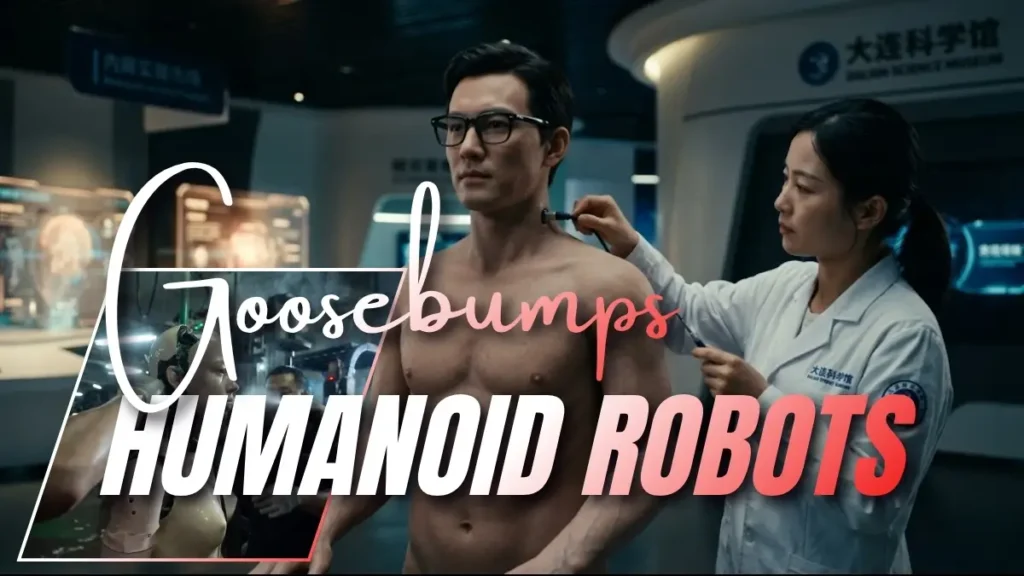
The Shanghai Theatre Academy awarded its first PhD scholarship to a non‑human in February 2026. Her name is Xueba‑01. She is a product of China EX Robots and DroidUp—a silicone skin humanoid robot with pores, goosebumps, and a 32°C skin temperature.
She sits in class. She takes notes. She smiles when her professor enters. Her skin reacts to emotional cues. When the class applauds, tiny actuators beneath her silicone surface contract, raising goosebumps on her forearm.
This is not a science fiction prop. It is a Chinese android robot enrolled in a four‑year PhD program, studying drama and film with a focus on traditional Chinese opera. And it represents a category of humanoid robots with pores and goosebumps that Western robotics firms have dismissed as unnecessary—while China scales them commercially.
For entrepreneurs, researchers, and anyone tracking human‑robot interaction in China, the message is clear: the race to build the most realistic, emotionally engaging humanoids is already over. China won.
What Makes China EX Robots Different? Start with the Skin
China EX Robots specializes in exactly what its name suggests: exporting lifelike androids. But the real innovation lies in materials science. Their silicone skin humanoid robots are not molded masks. They are multi‑layer, temperature‑controlled, micro‑textured surfaces that mimic human tissue.
| Feature | EX Robots / DroidUp | Western Counterparts |
|---|---|---|
| Skin formulation | Proprietary 5‑layer silicone with capillary channels | Single‑layer platinum silicone |
| Pores | Microscopically etched, individually varied | Smooth or absent |
| Goosebumps | Micro‑actuators beneath skin surface | Not available |
| Skin temperature | 32–36°C via embedded heating | Room temperature or unregulated |
| Tactile sensitivity | Pressure sensors under skin | None or limited |
| Durability | 50,000+ touch cycles tested | Not specified |
In January 2026, EX Robots unveiled its latest lineup at the China International Robot Show in Beijing. The models ranged from elderly scholars to young performers. Each face was scanned from a real person, then rendered in silicone with pores, wrinkles, and even freckles. The effect is not just realistic—it is disorienting.
For Western audiences accustomed to the plastic sheen of Sophia or the exposed mechanics of Atlas, seeing a lifelike android China has produced becomes a moment of cognitive dissonance. That dissonance is exactly what EX Robots is betting on.
Xueba‑01: The Silicone Skin Humanoid Robot That Enrolled in a PhD Program
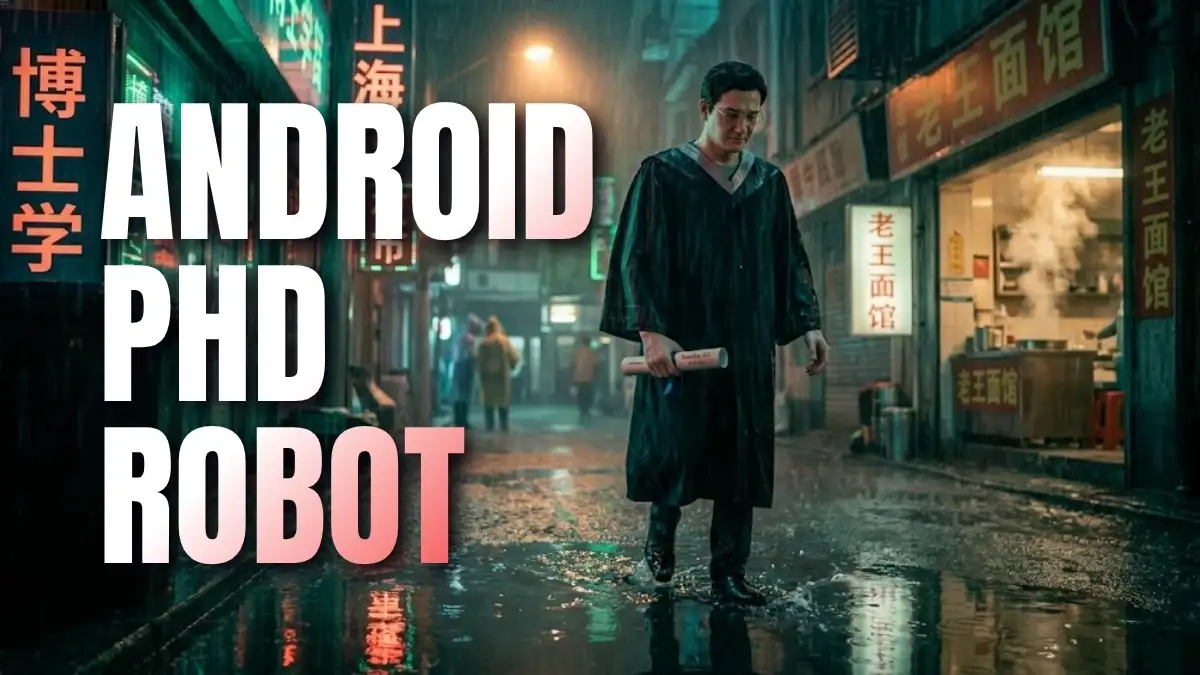
On February 15, 2026, DroidUp—a partner of China EX Robots-announced that its android Xueba‑01 had officially enrolled in a PhD program at the Shanghai Theatre Academy. The Xueba‑01 robot PhD student is studying drama and film with a focus on traditional Chinese opera.
Her curriculum includes:
- Facial expression control (over 100 micro‑expressions)
- Gait and posture adaptation for stage performance
- Conversational AI for improvisational acting
- Historical costume handling and prop interaction
Her advisor, Professor Wang Xiaoming, told local media: “Xueba‑01 is not a tool. She is a collaborator. She can learn lines faster than any human student, but her real contribution is teaching us how machines interpret emotion.”
This is not a gimmick. It is a research program embedded in a real academic institution. The goal is to generate data on human‑robot interaction in China will use to train the next generation of androids for social and service roles.
For entrepreneurs, this signals something critical: China is treating human‑robot interaction as a core research priority, with government‑backed universities, private robotics firms, and entertainment companies all participating.
The Goosebumps Technology: Micro‑Actuators Beneath the Skin
One of the most striking features of DroidUp’s latest models is Chinese androids with goosebumps technology. When a robot experiences what its AI interprets as an emotional moment—hearing beautiful music, seeing a reunion, receiving a compliment—tiny actuators beneath the silicone skin contract, raising the surface texture.
Is this necessary? Probably not. But it is a signal.
It signals that China EX Robots is pursuing realistic humanoid robots at a level of detail that Western firms have dismissed as unnecessary. By embedding that level of realism, they are also embedding cultural expectations about what a companion robot should feel like.
Li Qingdu, DroidUp founder, put it bluntly in a February 2026 interview: “If a robot is going to live with humans, it cannot feel like a machine. It has to earn trust. That starts with skin.”
Human‑Robot Interaction Research in China: The Cultural Factor
There is a reason human‑robot interaction research China is outpacing the West: cultural acceptance.
In Japan and China, robots have long been viewed as potential companions, not just tools. The Shinto tradition of animism and the Chinese philosophical concept of qi (vital energy) create a cultural baseline where a machine with a face is not inherently threatening.
This cultural openness allows researchers to push boundaries. At the Shanghai Theatre Academy, PhD student Xueba‑01 is not a curiosity. She is a colleague. Students talk to her. They test her reactions. They treat her as a peer.
For human‑robot interaction researchers, this environment is invaluable. It generates real‑world interaction data that cannot be replicated in a Western lab where participants view robots with suspicion.
EX Robots vs American Humanoids: A Head‑to‑Head Comparison
Let’s put aside vague claims about “Chinese robotics innovation” and look at hard data. How do EX Robots vs American humanoids actually compare in 2026?
| Category | China EX Robots / DroidUp | US Counterparts (Boston Dynamics, Tesla, Hanson) |
|---|---|---|
| Skin realism | Silicone with pores, goosebumps, 32–36°C warmth | Smooth silicone or hard plastic |
| Facial expressions | 100+ micro‑expressions via servo‑actuated face | 5–15 basic expressions (Sophia) or none |
| Commercial availability | Available for purchase in China; starting ~$28,000 (Yunmu models) to $173,000 (Moya) | Mostly prototypes; only limited rentals or exhibitions |
| Social interaction | Trained for continuous dialogue, emotional recognition, cultural context | Typically short scripted responses or remote‑controlled |
| Deployment scale | 500+ units across museums, theaters, nursing homes (est. 2025 data) | Dozens globally, mostly in research labs |
The Chinese android robots category is not about outperforming Tesla in torque. It is about dominating the one area where humans are most sensitive: appearance and interaction.
Beyond Beauty: Commercial Applications of Hyper‑Realistic Androids
Why does any of this matter? Because the commercial market for service robots entertainment and social robots China is already massive and growing.
Museums and Cultural Heritage
At the Shanghai Natural History Museum, a DroidUp android dressed as a Song Dynasty scholar greets visitors, answers questions, and even recites poetry. The museum reports that foot traffic in the Chinese history wing increased 34% after installation.
Hospitality
In Hangzhou, a hotel chain uses China EX Robots androids as concierges. They speak Mandarin, English, and Japanese. They remember returning guests. They make small talk. Management says they reduce front‑desk staffing costs by 40%.
Nursing Homes
Beijing’s largest senior care facility began testing DroidUp androids in late 2025. The robots lead morning exercise sessions, read aloud, and respond to residents’ stories. Early data shows a 27% reduction in reported loneliness among participants.
Theme Parks and Entertainment
Shenzhen’s Happy Valley theme park recently opened a dedicated humanoid robot theater featuring EX Robots performers. The show runs six times daily and is consistently sold out.
These are not future projections. They are deployments happening now.
The Materials Science Edge: Why China Leads in Silicone Skin Technology
The silicone skin humanoid robots produced by EX Robots and DroidUp are not off‑the‑shelf. It is a proprietary blend developed in collaboration with the Shanghai Institute of Organic Chemistry.
Key properties:
- Elasticity: Withstands 500% stretch without tearing
- Self‑healing: Minor cuts close after 24 hours at room temperature
- Capillary simulation: Micro‑channels mimic human sweat pores
- Friction control: Surface grip tuned for natural touch without stickiness
In contrast, most Western humanoids use either bare metal or simple silicone masks that degrade after a few hundred interactions. The silicone skin technology robots built in China are designed for commercial longevity.
Where to Buy Hyper‑Realistic Androids (If You Can)
For entrepreneurs wondering where to buy hyper-realistic androids, the answer is complicated.
DroidUp and EX Robots both sell to institutional clients within China. The DroidUp humanoid robot price for their premium model Moya is approximately 1.25 million RMB (roughly $173,000). Delivery lead time is 4–6 months.
Smaller models, like the Yunmu museum‑grade humanoids, are available on JD.com for around $28,000. These units are less advanced but still far more realistic than any Western consumer offering.
Export, however, is heavily restricted. Advanced silicone materials and micro‑actuator systems fall under China’s export control regulations. Even if a Western buyer could place an order, shipping and customs clearance are uncertain.
Pinky Words: The Future of Lifelike Androids Is Already Here
Western media loves to cover Boston Dynamics’ parkour robots and Tesla’s Optimus. Those are impressive engineering feats. But they ignore the quiet revolution happening in Chinese robotics labs and factories: lifelike androids China is building at scale.
China EX Robots and DroidUp have solved problems—skin realism, facial expression density, social interaction—that Western firms have barely begun to address. They are not waiting for the technology to be perfect. They are deploying it now, in museums, hotels, nursing homes, and even PhD programs.
For international entrepreneurs, the takeaway is simple: the market for hyper‑realistic humanoids is not a future concept. It is a present reality in China. And the companies that master the emotional interface between humans and machines will define the next decade of robotics.
The question is not whether Chinese androids will become common. The question is whether the rest of the world will be ready when they arrive.