China Autonomous Delivery Robots: 2.5 Million Units, 300 Cities, and a 317% Growth Rate That Left the United States in the Dust
American logistics executives spent 2025 in conference rooms debating whether sidewalk robots needed human chaperones. Chinese engineers spent the same year deploying 2.5 million autonomous delivery vehicles across 300 cities.
Table of Contents
The China Association of Automotive Engineers released the numbers in February 2026. The report was clinical. The implications were not.
Over 2.5 million functional unmanned vehicles were operating commercially in China by the end of 2025. That number grew 317% in a single year. Compare that to the United States, where the total number of autonomous delivery vehicles China has deployed in a single province exceeds America’s entire national fleet. California, the most advanced US state for autonomous vehicles, has issued permits for fewer than 500 delivery robots as of March 2026.
The gap is not 500 to 1. It is an order of magnitude that Western logistics companies cannot overcome.
This is not about technology. China autonomous delivery robots are not using secret hardware unavailable to American engineers. They are using the same LiDAR, the same cameras, the same AI models. The difference is not in the lab. It is on the street. It is in the regulatory framework. It is in the infrastructure. And it is in the scale of robot delivery commercial deployment that now makes American efforts look like hobby projects.
Meituan Autonomous Delivery Robots: The 7 Million Rider Problem That Automation Solved
How Many Delivery Robots Does Meituan Have? The 2026 Fleet Size Revealed
Meituan autonomous delivery robots represent the most visible segment of China’s automated logistics revolution. Meituan employs nearly 7 million delivery riders—a workforce larger than the active-duty military of most countries. In 2025, new labor protection laws in China added an estimated 15-20% to the company’s per-delivery labor costs. The solution was not to raise prices. It was to eliminate the rider.
Industry analysts estimate Meituan now operates between 10,000 and 15,000 autonomous units across Beijing, Shenzhen, and Shanghai. The company does not publicly disclose exact fleet numbers, but the growth trajectory is unmistakable. In 2024, Meituan’s autonomous delivery vehicles China division was a pilot project. By 2026, it is a core logistics operation.
These logistics robots Beijing Shenzhen represent the front line of a national strategy to automate last-mile delivery. Beijing’s Chaoyang District alone hosts thousands of Meituan sidewalk robots daily. Shenzhen’s Nanshan District sees similar density. The robot delivery commercial deployment is no longer experimental. It is routine.
Meituan Subway Restocking Robots: The Underground Network No US City Can Match
In late 2025, Beijing’s subway system began deploying Meituan subway restocking robots to service convenience kiosks inside stations. These China autonomous delivery robots navigate subway corridors during low-traffic hours, delivering snacks, drinks, and daily essentials to automated vending units.
The system solves a problem unique to megacities: how to restock hundreds of high-traffic retail points without clogging pedestrian flow. By moving restocking operations to autonomous vehicles that operate when stations are empty, Meituan reduced in-station logistics costs by an estimated 40%.
No American city has attempted anything similar. The bureaucratic hurdles alone would take years. Meanwhile, Beijing’s subway restocking robots Beijing are already expanding to Line 10 and Line 4, with plans for full network coverage by 2027.
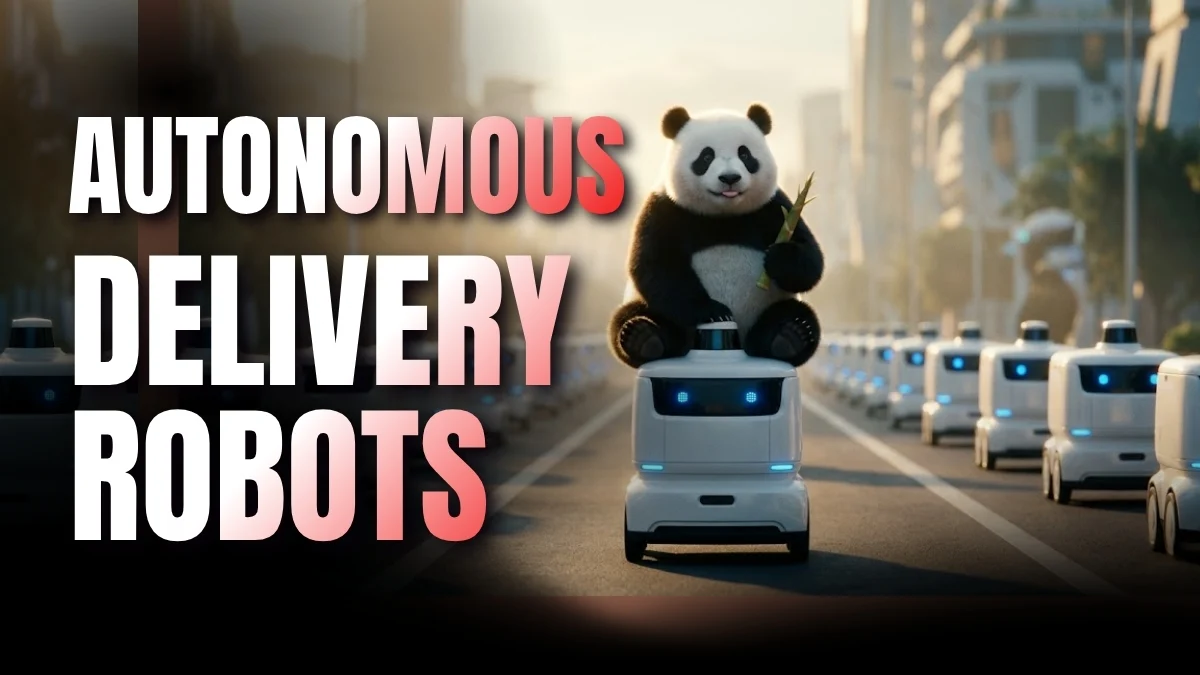
Sidewalk Delivery Robots China: Where 10,000 Robots Navigate Beijing Daily
The sidewalk network in Beijing’s central business district now features dedicated robot lanes. Small autonomous vehicles move alongside pedestrians, delivering food, packages, and even coffee. The system is so routine that residents no longer look twice.
Western media loves to cover a single Starship robot crossing a college campus. In China, sidewalk delivery robots China are a municipal utility. The delivery robots urban China phenomenon has transformed how residents receive goods. A 2025 survey by the China Logistics Information Center found that 73% of urban residents in first-tier cities had received a robot delivery in the past year.
Alibaba Cainiao Delivery Network: The Global Logistics Machine Going Fully Autonomous
Alibaba Cainiao Robot Delivery Network Scale: 40 Warehouses, 18 Countries, Zero Human Pickers
On March 12, 2026, Alibaba Cainiao delivery network announced a massive global expansion: the company will deploy next-generation robotic warehouses across Hong Kong, the United States, and key European markets including the Netherlands, Spain, France, and Germany.
The new warehouses feature three proprietary technologies developed through the Cainiao robotics platform:
- Self-developed warehouse robots capable of operating in high-density storage configurations
- Physical AI scheduling systems that manage entire robot fleets in real-time
- Storage density improvements of 20-30% over traditional warehouses
Shuai Yong, Vice President of Cainiao and General Manager of the Global Supply Chain Division, told reporters that the robotic network will dramatically expand next-day and two-day delivery coverage across Europe and the US.
Currently, Cainiao operates more than 40 overseas warehouses across 18 countries—a footprint no Western logistics company can match. The shift to autonomous operations represents a fundamental restructuring of cross-border e-commerce logistics, powered by last-mile automation China has pioneered.
Are There Robot Deliveries in China? The Data Says 2.5 Million Units and Counting
The question itself reveals how far behind Western understanding has fallen. “Are there robot deliveries in China” is like asking if there are cars on American highways. The answer is yes, and they have been there for years.
The 2.5 million figure from the China Association of Automotive Engineers includes:
- Sidewalk delivery robots China (Meituan, JD.com, Neolix)
- Autonomous vans (Neolix, Cainiao)
- Meituan subway restocking robots
- Warehouse AGVs (Cainiao, JD.com)
- Delivery drones (Meituan, JD.com)
Each category is operating at commercial scale. Each category has regulatory approval. Each category is expanding. The robot courier services industry in China generated an estimated $8.3 billion in revenue in 2025, according to the China Logistics and Purchasing Federation.
JD.com Delivery Robots: The Singles’ Day Stress Test That Broke Every Record
JD.com Singles’ Day Robot Statistics: 700 AGVs in One Warehouse Alone
On November 11, 2025, JD.com delivery robots were put to the ultimate test. Behind the scenes, 700 automated guided vehicles (AGVs) operated in Cainiao’s Wuxi IoT Future Park alone—the largest automated warehouse in China.
That was one facility.
Across JD’s national network, the company deployed what it calls its “Wolf Pack” strategy: a multi-year plan to progressively replace human labor with autonomous systems. The targets are aggressive: roughly 3 million delivery robots, 1 million autonomous vans, and 100,000 drones over a five-year timeline.
3 Million Delivery Robots, 1 Million Vans: Inside JD’s “Wolf Pack” Strategy
The Wolf Pack strategy is not a press release. It is an operational roadmap with specific milestones:
- 2024: Pilot deployments in 10 cities
- 2025: Expansion to 50 cities; 2.5 million total units across all operators
- 2026: National coverage; integration with JD’s logistics AI platform
- 2027: Full automation of JD’s last-mile delivery network
The results from Singles’ Day 2025 validated the approach. Sales of smart robots jumped fivefold year-over-year. JD’s AI-powered digital humans assisted more than 40,000 merchants in livestreaming sessions. Intelligent customer service chatbots handled over 4.2 billion inquiries.
These are not incremental improvements. These are exponential leaps enabled by AI logistics China has integrated into every layer of its supply chain.
Technical Architecture: How China Autonomous Delivery Robots Navigate Chaos
SLAM, Computer Vision, and the AI That Keeps Robot Couriers Moving
The technical backbone of China autonomous delivery robots rests on three pillars: SLAM (Simultaneous Localization and Mapping) for navigation, computer vision for obstacle detection, and cloud fleet management for coordination.
Autonomous delivery vehicles China typically use:
- LiDAR sensors for 360-degree environmental mapping
- Stereo cameras for depth perception and object recognition
- IMU (Inertial Measurement Units) for positioning when GPS is unavailable
The real innovation is in the AI models. Chinese companies have trained their systems on urban environments that are among the most complex in the world—narrow alleyways, unpredictable pedestrian behavior, and chaotic traffic patterns. A robot courier services vehicle that can navigate Beijing can navigate anywhere.
Cloud Fleet Management: The Brain Behind Robot Delivery Commercial Scale
Each autonomous vehicle connects to a central cloud platform that monitors location, battery level, and task status. When a robot encounters a situation it cannot handle—a blocked path, a malfunction, an unexpected obstacle—the cloud system either reroutes the vehicle or dispatches a human operator to intervene remotely.
This centralized architecture allows Chinese operators to manage fleets of tens of thousands of robots with minimal human oversight. Western competitors, operating with fleets of dozens or hundreds, simply cannot generate the data needed to optimize these systems at scale. The automated delivery infrastructure China has built is simply not replicable in fragmented regulatory environments.
The US Failed. China Built. Here Is Why the Gap Will Never Close
US Regulatory Barriers: Why California Has 500 Robots While Shenzhen Has 50,000
In the United States, autonomous delivery companies operate under a patchwork of city-level permits. Each deployment requires months of negotiation with local transportation departments, police, and community boards.
California, the most advanced US state for autonomous vehicles, has issued permits for fewer than 500 autonomous delivery vehicles as of early 2026. Federal regulations for autonomous trucks remain in development with no clear implementation timeline.
Meanwhile, Shenzhen alone hosts an estimated 50,000 autonomous delivery vehicles in China. The difference is not technology. It is governance.
Infrastructure Differences: Wide Sidewalks, Robot Lanes, and Cities Built for Automation
Chinese cities are built differently. Wide sidewalks, designated bike lanes, and uniform street layouts make autonomous navigation easier. More importantly, Chinese cities have embraced the concept of “robot-only” lanes and delivery zones—dedicated automated delivery infrastructure that simply does not exist in American cities.
When Beijing builds a new residential complex, it now includes robot delivery bays. When Shenzhen renovates a commercial district, it installs robot charging stations. The infrastructure is designed for last-mile automation China from the start.
Public Acceptance in China: The Cultural Factor Western Entrepreneurs Ignore
Western media likes to frame public acceptance as a barrier to autonomous delivery. In China, it is not a barrier. It is a selling point.
Chinese consumers have been using mobile payments for over a decade. They scan QR codes without thinking. They interact with automated kiosks daily. The leap to accepting delivery robots urban China was not a leap at all. It was a small step.
American consumers, by contrast, still debate whether self-checkout machines are an invasion of privacy. The cultural gap in technology acceptance is as wide as the regulatory gap.
The Regulatory Machine: How China Built an Automated Delivery Infrastructure in 36 Months
National Robotics Policy: The “AI + Transportation” Guidelines That Changed Everything
In 2025, the Ministry of Transport, National Development and Reform Commission, and Ministry of Industry and Information Technology jointly issued the “Artificial Intelligence + Transportation” Implementation Guidelines. The document explicitly called for cities to “open up scenarios and road networks” for autonomous delivery.
This was not a suggestion. It was a directive.
By February 2026, nearly 300 Chinese cities had deployed functional unmanned vehicles under a standardized “road test—demonstration application—commercial operation” framework. The framework removed the uncertainty that paralyzes American regulators.
City-Level Pilot Programs: Shenzhen, Hangzhou, and the Race to Attract Robot Fleets
Shenzhen passed a local law in 2024 establishing liability frameworks for autonomous vehicles—including the provision that owners, not operators, bear responsibility for accidents when vehicles operate without a human driver.
Hangzhou went further, opening all eight urban districts to autonomous vehicle testing—the largest contiguous testing zone in the world.
Cities compete to attract autonomous delivery vehicles China companies. The companies bring jobs, investment, and technological prestige. In the United States, cities compete to keep them out.
Where to See Delivery Robots in China: A City-by-City Guide for Entrepreneurs
For entrepreneurs who want to see China autonomous delivery robots in action, here is where to look:
- Beijing: Meituan autonomous delivery robots in Chaoyang District; subway restocking robots Beijing on Line 10
- Shenzhen: JD.com delivery robots in Nanshan District; Meituan drones in Longhua
- Shanghai: Cainiao robotics platform warehouse robots in the Lingang area; sidewalk delivery robots China in Pudong
- Hangzhou: Full urban district access; highest density of autonomous delivery vehicles China per capita
- Suzhou: Neolix autonomous convenience stores (mobile robot courier services)
Each city offers a different deployment model. Each city is years ahead of anything in the United States.
Conclusion: The Window for Catching Up Slammed Shut in 2025
The numbers are now public. China deployed 2.5 million autonomous delivery vehicles in 2025—over 99% of the global total. The country’s leading logistics companies are not testing robots. They are replacing human workers with them at a scale that will permanently alter the economics of delivery.
For international entrepreneurs, three lessons are undeniable:
First, regulatory strategy matters more than technology. China’s autonomous delivery industry succeeded not because Chinese engineers are better—though they are excellent—but because the government created a clear, predictable path from testing to commercial operation. American entrepreneurs spent 2025 in regulatory limbo. Chinese entrepreneurs spent 2025 scaling.
Second, scale creates unbeatable advantages. Every mile driven by China’s China robot delivery fleet generates data that makes the next generation cheaper and more capable. Western companies, with their fleets of dozens or hundreds, cannot compete with that data advantage. They will never catch up.
Third, the window for catching up is closed. If the United States and Europe do not establish national frameworks for autonomous last-mile delivery China has already mastered, the gap in deployment experience will become effectively permanent. But 2025 was the year China crossed the threshold. The race is over.
China autonomous delivery robots are not coming. They are already here. And they are delivering 40 million parcels a year in a country that decided, years ago, that the future of logistics would not involve a driver.
The only question left is whether American logistics executives will stop debating and start copying.