FOODOM Robot Restaurant China: Inside the Fully Automated Restaurant Complex Cooking 200+ Dishes Without a Single Chef
Table of Contents
The year is 2026. You walk into a two‑story glass building in Foshan, China. A screen greets you with 200 menu options. You tap a few selections. Behind the glass wall, 40 robotic arms begin moving. Woks tilt. Steam rises. Noodles are tossed. Sauces are measured to the milliliter. Ninety seconds later, a robotic arm slides your meal onto a conveyor belt. A delivery robot carries it to your table. You eat. You pay. You leave.
You never saw a human being.
This is not a concept. This is FOODOM robot restaurant China—the world’s first fully automated restaurant complex—operating at commercial scale since 2024. While American food chains are still testing a single robotic fryer in a back kitchen, China has already opened an entire building where machines do everything from chopping vegetables to serving customers.
And the company behind it, EncoSmart, just did something no Western competitor has dared attempt: they got a government‑issued food operation license for an AI cooking robot.
The World’s First Fully Automated Restaurant Complex Opens in Foshan
Where Is the World’s First Robot Restaurant Complex? The Answer Is Foshan
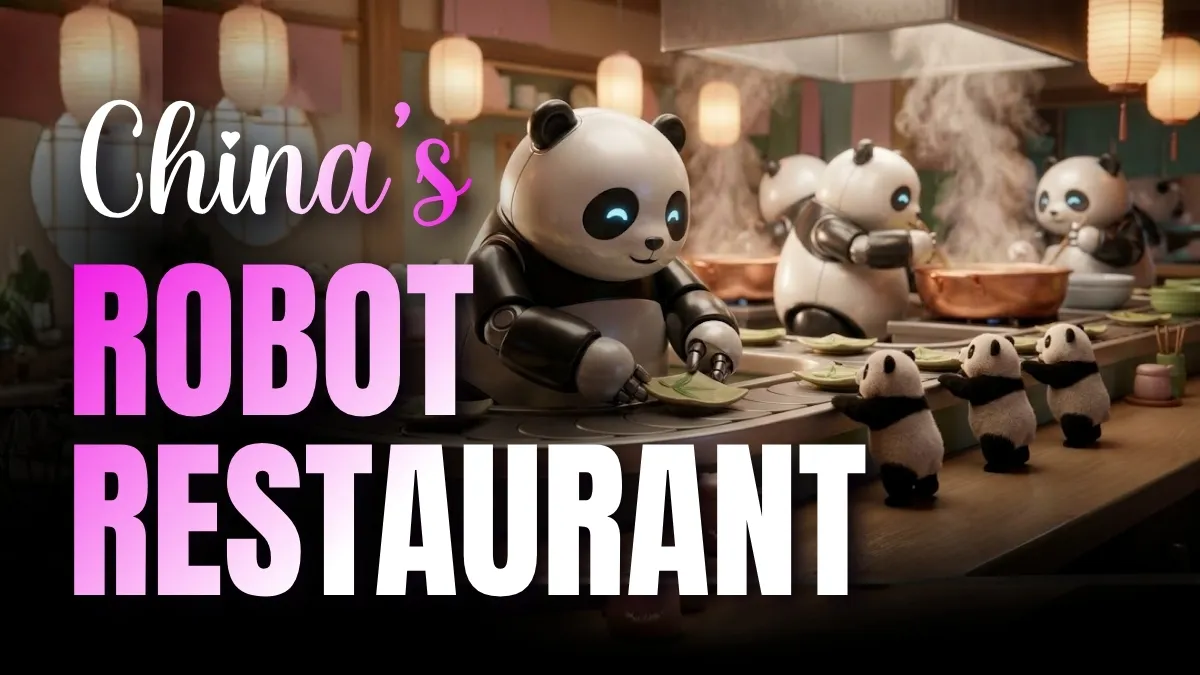
In the heart of Guangdong province, a 2,000‑square‑meter facility operates 24 hours a day with a staff of zero. The fully automated restaurant China has been called “FOODOM Robot Restaurant Complex” since its launch, and it has served over 500,000 customers without a single kitchen employee.
The location was not random. Foshan is China’s kitchen appliance manufacturing capital—the city where industrial automation meets food. The same supply chain that produces millions of rice cookers and woks now produces robotic chefs.
40 Robots, 2,000 Square Meters, Zero Human Chefs
The complex houses 40 distinct robotic systems, each specialized for a different cooking method:
- Wok robots for stir‑fry
- Steaming robots for dim sum
- Noodle‑cooking robots for soups
- Rice‑cooking robots for clay pot dishes
- Sauce‑dispensing robots calibrated to 0.1‑gram precision
- Delivery robots that navigate between floors
Every dish is prepared, cooked, and delivered without a single human hand touching the ingredients. The only humans on site are maintenance technicians and a single cashier—and even the cashier is optional, as the complex accepts mobile payments exclusively.
EncoSmart AI Cooking Robot: The Machine That Earned China’s First Food Operation License
EncoSmart AI Cooking Robot Price and Technical Specifications
EncoSmart is the technology arm behind FOODOM. Their AI chef robot is not a single machine but a modular cooking system that can be configured for any cuisine.
Key specifications:
| Feature | Specification |
|---|---|
| Cooking precision | 0.1‑gram ingredient measurement |
| Temperature control | ±1°C accuracy |
| Cooking speed | 90 seconds average per dish |
| Menu capacity | 200+ dishes pre‑programmed |
| Learning capability | AI analyzes customer preferences and adjusts recipes |
| Unit cost (commercial) | Approximately $18,000–$25,000 per cooking module |
The EncoSmart AI cooking robot is already deployed in over 100 commercial kitchens across China, but the FOODOM complex represents its most ambitious installation.
First Food License for AI Cooking Robot China: What the 2025 Ruling Means
In late 2025, EncoSmart achieved something no Western food automation company has: a government‑issued food operation license specifically for an AI cooking robot.
The license, granted by the Beijing Municipal Market Supervision Administration, formally recognizes the AI chef robot as a legally permitted food handler. It specifies that:
- The robot meets all food safety standards for commercial kitchens
- No human chef is required to supervise its operation
- The license holder (EncoSmart) assumes full liability for food quality
This single document changed everything. Without it, automated restaurants exist in a regulatory gray zone. With it, FOODOM robot restaurant China can scale nationwide without waiting for city‑by‑city approvals.
Western food automation companies like Spyce, Miso Robotics, and Chowbotics have spent years trying to navigate the fragmented US regulatory landscape. None have secured a national‑equivalent license. None operate at scale. While American entrepreneurs are still explaining to health inspectors what a robot is, China already issued the permit.
How a Robot Restaurant China Works: From Order to Plate in 90 Seconds
How Does FOODOM Robot Restaurant Work? The Full Customer Journey
The customer journey at FOODOM is designed for speed and spectacle:
- Order: Customers select dishes from touchscreens or their phones. The system confirms ingredient availability in real time.
- Ingredient retrieval: Automated storage systems retrieve raw ingredients from refrigerated vaults.
- Cooking: The robot cooking commercial kitchen assigns each dish to the appropriate robotic station. Wok robots tilt and toss. Steamers activate. Sauces are dispensed.
- Assembly: Finished dishes are placed on a conveyor belt by robotic arms.
- Delivery: A separate fleet of delivery robots transports the meal to the customer’s table.
- Payment: Mobile payment is automatic. No cash. No cards.
Total time from order to table: 90 seconds for most dishes.
Robot Cooking Commercial Kitchen: The Technology Stack Behind Automated Woks
The robot cooking commercial kitchen at FOODOM is built on three layers:
- Hardware: Custom‑built robotic arms, wok stations, steamers, and conveyor systems manufactured by EncoSmart’s partner factories in Foshan
- Software: A central AI system that manages order queuing, ingredient allocation, and cooking timing to ensure all dishes for a single table finish simultaneously
- Cloud: Real‑time data collection on cooking times, ingredient usage, and customer preferences that feeds back into recipe optimization
The system learns. If customers consistently order spicier versions of a dish, the AI adjusts the chili oil dispenser. If a particular dish takes too long, the system re‑routes it to a different cooking station.
No human chef can operate at this level of consistency. No human chef can scale across 40 stations simultaneously.
40 Robots, 200 Dishes: What FOODOM’s Fully Automated Restaurant Actually Serves
China Robot Restaurant 200 Dishes: From Sichuan Hot Pot to Cantonese Dim Sum
The China robot restaurant 200 dishes claim is not marketing hype. The FOODOM complex serves:
- 30 varieties of dumplings (steamed, fried, boiled)
- 25 noodle dishes across five regional styles
- 40 stir‑fry dishes with customizable spice levels
- 15 rice dishes including clay pot rice and fried rice
- 20 soups from light broths to hearty stews
- 10 desserts including sweet tofu pudding and sesame balls
- 60 rotating seasonal specialties
The menu covers more ground than most human‑staffed restaurants in the same price category.
Fully Automated Restaurant Experience: What Customers Actually Say
Customer reviews from Chinese food platforms paint a consistent picture:
- Speed: “I was in and out in 15 minutes. At a human restaurant, I’d still be waiting for my drink.”
- Consistency: “The mapo tofu tastes exactly the same every time. No chef mood swings.”
- Value: “Prices are 20% lower than nearby restaurants. No labor costs to pass on.”
The fully automated restaurant experience is not about replacing fine dining. It is about solving the problems that plague fast casual and quick service restaurants: labor shortages, inconsistent quality, and rising costs.
The Regulatory Breakthrough: China’s First AI Cooking Robot Food License
EncoSmart Food Operation License: How a Robot Legally Became a Chef
The EncoSmart food operation license was not handed out casually. Beijing’s market regulators spent 18 months evaluating the system before issuing the license in November 2025.
The evaluation covered:
- Food safety protocols (temperature control, cross‑contamination prevention)
- Ingredient traceability (each component tracked from supplier to plate)
- Cleaning and sanitation (automated self‑cleaning cycles for all cooking surfaces)
- Liability frameworks (who is responsible when a robot makes a mistake)
EncoSmart passed every test. The license now serves as a template for other Chinese cities. By early 2026, Shenzhen, Shanghai, and Guangzhou had issued similar permits. The national standardization process is underway.
Why Beijing Issued the License and What It Signals for Food Automation
Beijing’s decision to issue the first AI chef robot license signals a deliberate policy direction: China intends to lead the global food automation industry.
The license creates a clear path to market. Any company that can meet the standards can apply. Compare this to the United States, where food automation companies must navigate 50 different state health departments, each with its own interpretation of what a “kitchen employee” means.
The result? American startups spend years in regulatory purgatory. Chinese companies deploy at scale.
Robot Cooking Commercial Kitchen Economics: Why Automation Beats Human Labor
Labor Cost Comparison: Robot vs Human Chef in China
The economics of robot cooking commercial kitchen are brutal for human labor.
| Cost Factor | Human Chef Team (20 staff) | EncoSmart Robot System |
|---|---|---|
| Annual labor cost (China avg) | $120,000–$180,000 | $0 |
| Training cost | $5,000–$10,000 per new hire | $0 (software updates) |
| Turnover rate | 30–50% annually | 0% |
| Consistency variance | ±15% dish‑to‑dish | ±2% |
| Operating hours | Limited by labor laws | 24/7 |
The math is simple. A fully automated restaurant China can operate at 20–30% lower cost than a human‑staffed competitor while maintaining higher consistency.
ROI Timeline for Fully Automated Restaurant China Operators
For investors, the numbers are compelling. A typical FOODOM franchise installation costs approximately $300,000–$500,000 for equipment and build‑out. With lower operating costs and 24/7 revenue potential, operators report breakeven in 18–24 months—significantly faster than traditional restaurant investments.
Why Robot Restaurants Exist at Scale in Foshan But Not in Silicon Valley
FOODOM vs Spyce Robot Kitchen: What Happened to the American Competitor
American entrepreneurs love to point to Spyce—a Boston‑based automated restaurant that opened in 2018 with significant hype. By 2023, Spyce had closed its flagship location and pivoted to selling its technology rather than operating restaurants. The company cited “the complexities of running a full‑service restaurant” as the primary challenge.
The difference between Spyce and FOODOM robot restaurant China is not technology. It is infrastructure.
FOODOM operates in a country where:
- A single national regulatory framework allows rapid expansion across cities
- Manufacturing supply chains for robotics components exist at scale
- Consumer acceptance of automation is high (China already leads the world in mobile payment and QR code adoption)
- Government policy explicitly supports automation in service industries
Spyce operated in a country where:
- Every city requires separate health department approvals
- Manufacturing costs for custom robotics are 2–3x higher
- Consumer skepticism about automation is significant
- No federal policy supports food service automation
US Regulatory Barriers and Labor Union Dynamics
The United States presents unique obstacles. State health departments require a “person in charge” with food safety certification for every kitchen. Most states interpret this as a human being. No state has yet issued a license equivalent to what EncoSmart secured in Beijing.
Labor unions add another layer of resistance. The hospitality workers’ union UNITE HERE has actively opposed automation in restaurants, arguing it eliminates jobs. In 2024, the union successfully lobbied for a bill in California requiring human oversight of any automated food preparation equipment—effectively banning fully automated restaurants in the state.
These political dynamics do not exist in China. The government views automation as a productivity tool, not a job threat. Workers are retrained, not protected from technological change.
Where to Experience a Robot Restaurant China: The 2026 Expansion Map
Robot Restaurants in Foshan China: A Complete Visitor Guide
Foshan remains the headquarters of robot food service China. The original FOODOM complex at 118 Jihua Road is open daily from 10 AM to 10 PM. Reservations are recommended on weekends, though walk‑ins are generally accommodated.
The experience is designed to be tourist‑friendly. Menu screens offer English translations. Payment can be made with international credit cards via Alipay or WeChat Pay (tourist versions available).
Best Robot Restaurants in China: Beyond FOODOM
FOODOM is not alone. By early 2026, robot restaurants in China had expanded beyond Foshan:
- Haidilao Smart Restaurant (Beijing): The hot pot chain operates a partially automated location with robotic broth dispensers and delivery robots
- JD.com Robot Restaurant (Shenzhen): A fully automated noodle shop operating inside JD’s headquarters
- KFC Original+ (Shanghai): A pilot location with robotic fryers and automated order kiosks
- Meituan Drone Delivery (Shenzhen): Not a restaurant, but a delivery system that integrates with automated kitchen partners
The pattern is clear. Automation is not a novelty. It is the baseline.
Conclusion: The Future of Food Is Already Cooking in Foshan
Western media loves to cover robotic burger flippers and pizza‑making machines. They treat each deployment as a curiosity. But in China, FOODOM robot restaurant China has already moved past curiosity into commercial scale.
The fully automated restaurant China is not a future concept. It is a present reality serving hundreds of thousands of customers. The EncoSmart AI cooking robot holds a government license that American competitors cannot obtain. The robot cooking commercial kitchen economics are so compelling that expansion is limited only by manufacturing capacity, not demand.
For entrepreneurs, the lesson is not about robots. It is about execution. China built the regulatory framework, the supply chain, and the consumer acceptance necessary for food automation to scale. The United States did not.
While American entrepreneurs are still explaining to city councils what a robot is, China is serving its 500,000th automated meal. The gap is not closing. It is accelerating.
The only question left is whether the rest of the world will wake up before the kitchen closes.