BubblePal and FoloToy: Inside China’s AI Toy Market That Just Sold 500,000 Units
The first time a parent hears their child having a real conversation with a toy, something shifts. It is not just a recorded phrase or a button that plays a song. The toy listens. It responds. It remembers what the child said yesterday and asks about it today.
In 2024, Shenzhen startup Haivivi launched BubblePal AI toy – a small bubble‑shaped device that clips onto any plush toy and turns it into a talking companion. By early 2026, it had sold 200,000 units. Meanwhile, FoloToy, another Shenzhen‑based company, had grown from 20,000 units in 2024 to a projected 300,000 units in 2025.
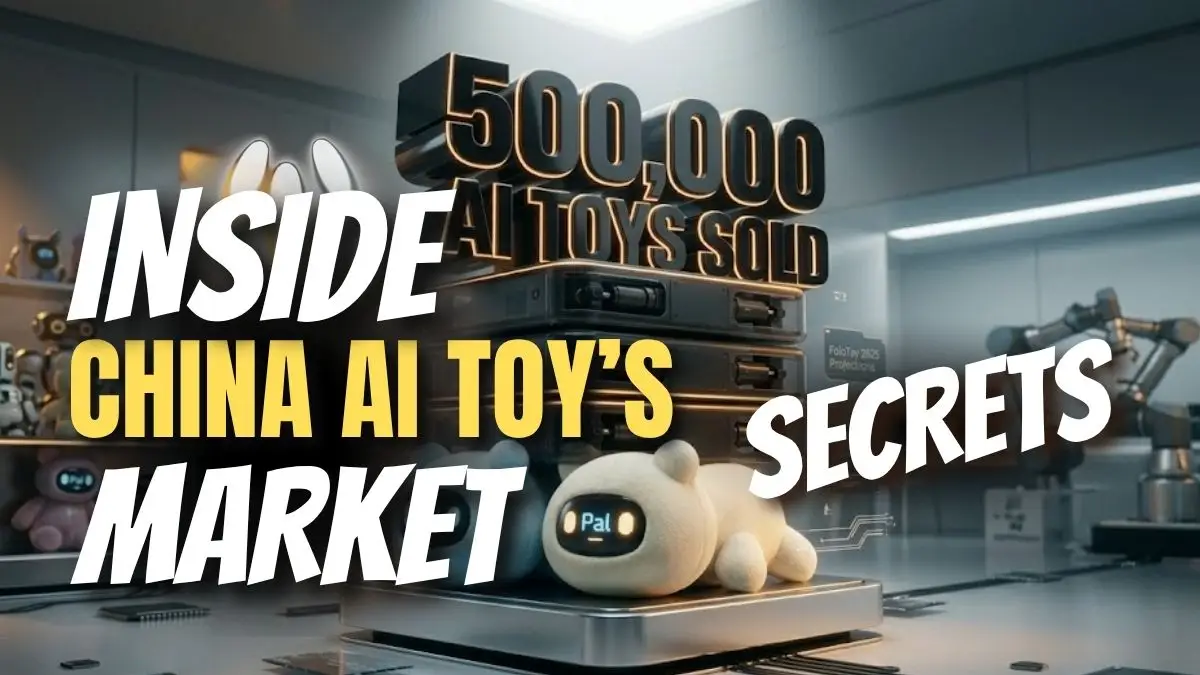
Together, these two companies have sold half a million AI companions. They are part of a China AI toy industry now counting over 1,500 companies, a number that has nearly doubled in two years. The market is projected to reach $14 billion by 2030.
But if you talk to parents who actually bought these toys, you hear something unexpected. Some say the conversations are too long. Others say the voice recognition fails when their toddler speaks. The toys sell anyway – because parents are desperate for something their children can talk to that does not involve a screen.
This is the honest story of AI children toys China. Not hype. Not fear. Just the reality of 500,000 families trying to figure out if a machine can be a friend.
The Numbers Behind the Boom: BubblePal Sales 200000 Units and FoloToy 2025 Projections
BubblePal AI toy Reaches 200,000 Units in 18 Months
BubblePal launched in 2024 with a simple pitch: clip it onto any stuffed animal, connect it to an app, and the toy talks back. No screen. No buttons. Just voice.
The company does not publicly release monthly sales figures, but multiple industry reports confirm that by March 2026, BubblePal AI toy had crossed 200,000 units sold. That is roughly 11,000 units a month – impressive for a device priced at 799 RMB (about $110) in China.
What drove the sales? Parents tired of seeing their children glued to iPads. BubblePal offered a screen‑free alternative that still felt magical. One parent told a tech reviewer: “My daughter talks to her bunny like it is alive. She even tells it secrets.”
FoloToy smart toys Targets 300,000 Units for 2025 – A 15x Leap
FoloToy took a different path. Instead of a universal clip‑on device, it builds voice‑enabled toys from scratch – cuddly animals, cartoon characters, even a dinosaur. The company’s growth has been even steeper.
In 2024, FoloToy sold about 20,000 units. For 2025, founder Larry Shi publicly stated a target of 300,000 units – a 15x increase. The confidence comes from a combination of strong Spring Festival sales and expansion into international markets.
A Securities Times report from February 2026 noted that during the Lunar New Year holiday, FoloToy’s sales grew 500‑fold compared to the same period the previous year. That is not a typo: 500x. The company now ships to over 10 countries and supports 10 languages.
What Makes AI Children Toys China Different from Traditional Toys
Conversational AI toys That Actually Hold a Child’s Attention
Traditional talking toys have a limited script. Press a paw, hear one of ten pre‑recorded phrases. After five minutes, the child has heard them all.
AI children toys China, by contrast, use large language models (LLMs) to generate infinite responses. BubblePal runs on DeepSeek, the same LLM that powers many Chinese AI applications. FoloToy uses a combination of models, including its own fine‑tuned versions.
This means a child can ask “Why is the sky blue?” and get a simple, age‑appropriate explanation. They can ask it again the next day, and the toy might answer differently, or ask back, “Did you see any clouds today?” The conversation never repeats.
Intelligent companion toys Designed for Screen‑Free Engagement
The killer feature for both products is the absence of a screen. Parents are not buying a tablet. They are buying a stuffed animal that talks. The child does not watch anything. They just listen, speak, and imagine.
One FoloToy parent described the experience: “My son has a panda that tells him stories before bed. He falls asleep holding it. I could never do that with an iPad.”
Educational robotics China Meets Emotional Support
Both companies position their products as educational. BubblePal’s app lets parents track what topics their child is curious about. FoloToy offers “knowledge cards” that unlock themed conversations about science, nature, or history.
But the emotional side is what keeps children coming back. In user reviews, parents frequently mention that the toy becomes a confidant – someone their child talks to about fears, dreams, or just daily events.
The Technology Powering DeepSeek AI Toys China
DeepSeek powered toys List: How BubblePal and FoloToy Use the Same LLM
DeepSeek, developed by Chinese AI company DeepSeek (a subsidiary of High‑Flyer), has become a popular backend for consumer AI products because it is powerful yet cost‑effective. BubblePal was one of the first toys to integrate DeepSeek.
FoloToy also uses DeepSeek for some of its models, though the company maintains its own fine‑tuned versions to better handle children’s speech patterns and safety requirements.
What makes DeepSeek powered toys different from those using Western LLMs is the cultural context. The models are trained on Mandarin‑first data, which means they handle Chinese language nuances – like tone, politeness levels, and local expressions – more naturally. This is critical for toys that need to sound like a friendly companion, not a translation bot.
AI toys for kids That Speak Multiple Languages – FoloToy’s 10+ Language Support
FoloToy’s rapid global expansion is built on its multi‑language capabilities. The company supports over 10 languages, including English, Spanish, Arabic, Japanese, and Korean. When a child speaks in their native language, the toy responds in the same language without any switching or lag.
This multilingual approach has opened markets across Europe, the Middle East, and Southeast Asia. For immigrant families in China, it also means their child can interact with the toy in their home language – a feature that resonates deeply.
How the China’s AI Toy Market Scaled to 1,500 Companies
China toy market innovation Accelerated by Shenzhen’s Hardware Ecosystem
Shenzhen is often called the hardware capital of the world. Thousands of component suppliers, manufacturing lines, and design firms operate within a few kilometers of each other. This ecosystem allows AI toy startups to prototype quickly and iterate at low cost.
A new company can design a toy, source custom chips, and have a working prototype in weeks – not months. By the time a traditional toy company like Mattel or Hasbro completes market research, a Shenzhen startup is already shipping its third version.
AI companion devices Go from Niche to Mainstream in 36 Months
Three years ago, AI companion toys were a novelty. Today, they are a category. According to the Shenzhen Toy Industry Association, the number of companies entering the space grew from fewer than 100 in 2023 to over 1,500 by early 2026.
The shift happened because the underlying technology – LLMs, voice recognition, and edge AI chips – became cheap and accessible. A startup can now license a model, buy off‑the‑shelf hardware, and launch a product for a fraction of what it cost five years ago.
China AI Toy Market Model: Why Chinese Edtech Robotics Commands Premium Pricing
Interactive AI toys with Recurring Engagement, Not One‑Time Play
What’s the China’s AI Toy Market Model actually? Traditional toys are one‑time purchases. A child plays with them until boredom sets in, then they sit on a shelf. AI toys are different. Because they generate new content every day, engagement is ongoing. Some parents report their child interacting with the toy for months without losing interest.
This ongoing engagement allows companies to charge premium prices. BubblePal’s 799 RMB price is about 2‑3x the average price of a premium plush toy. FoloToy’s products range from 300 to 1,200 RMB depending on complexity.
Chinese consumer AI products Achieve 70–80% Gross Margins
According to the Economic Observer, AI toy gross margins range from 70% to 80% – far higher than the 40–50% typical for traditional toys. The difference is in the cost structure. Hardware components (plastic, stuffing, chips) are cheap. The value is in the software and AI model, which has near‑zero marginal cost once developed.
This high margin explains the flood of new entrants. Even a small startup can achieve profitability with relatively low sales volumes.
BubblePal vs FoloToy Comparison – Which Intelligent Companion Toy Fits Your Child?
Best AI toys made in China for Different Age Groups
BubblePal works best for children aged 3 to 8. Its clip‑on design means parents can attach it to a favorite existing toy, which eases the transition. The app lets parents review conversations and set content filters.
FoloToy offers a wider range of characters – dinosaurs, bears, rabbits – that come pre‑built with the AI inside. Some models are designed for younger children (ages 2 to 5) with simpler vocabulary, while others target 5 to 10 year‑olds with more advanced conversation abilities.
BubblePal AI toy price and review vs FoloToy’s Customization Options
BubblePal costs about 799 RMB for the device, plus a subscription fee (around 79 RMB per month) for continued AI access after the first year. FoloToy’s pricing is per toy, with no subscription for basic functions, though advanced features may require a paid tier.
Parents who want customization often prefer FoloToy because they can choose a character their child loves. Parents who want a simple, screen‑free solution that works with any existing toy tend to choose BubblePal.
Where to Buy Chinese AI Toys and What to Expect
Where to buy Chinese AI toys – Online Platforms and Retail Chains
Both BubblePal and FoloToy are available on major Chinese e‑commerce platforms like JD.com and Tmall. They are also sold in physical toy stores, especially in first‑tier cities like Beijing, Shanghai, and Shenzhen.
For international buyers, both companies have started shipping to overseas markets. BubblePal launched in the US in late 2025, while FoloToy has distribution partners in Europe and the Middle East.
AI companion toys for children – Parent Reviews and Real‑World Feedback
Not all reviews are glowing. Some parents report that the voice recognition struggles with toddlers’ unclear speech. Others say the AI responses can be too long or overly complex for young children. A few note that children lose interest after the novelty wears off – though this happens with any toy.
But the majority of reviews highlight the emotional connection. One parent wrote: “My daughter told the toy she was scared of the dark. It told her a story about a brave little firefly. She slept with the light off for the first time.”
The Future of China AI Toy Market Size 2026 and Beyond
China AI toy market size 2026 Projected to Reach $14 Billion by 2030
The Shenzhen Toy Industry Association projects that the China AI toy market will grow from an estimated $2.5 billion in 2025 to $14 billion by 2030. This growth is driven by falling hardware costs, improving AI models, and increasing parental demand for screen‑free engagement.
China AI toy companies 2026 – Who Are the Emerging Players
Beyond BubblePal and FoloToy, dozens of startups are entering the space. Some focus on specialized niches: toys for children with autism, language‑learning companions, or toys that integrate with smart home devices. The competition is fierce, but the market is large enough to support many players.
What will separate the winners from the rest? According to industry observers, the key is user experience. Parents will pay a premium for a toy that consistently works, understands their child’s speech, and generates conversations that feel genuinely warm – not just technically correct.
Pinky Workd: 500,000 Families Have Already Made the Leap
BubblePal sold 200,000 units. FoloToy sold 20,000 in 2024 and expects 300,000 in 2025. That is half a million families in China who have already invited an AI companion into their home. They did so not because the technology is perfect – it is not – but because the alternative (screens) felt worse.
The China AI toy industry now includes over 1,500 companies, and the market is projected to reach $14 billion by 2030. The toys are not replacing parents or teachers. They are filling a gap: a screen‑free companion that listens, answers, and remembers.
If you ask a child why they love their talking bunny or their smart dinosaur, they will not mention large language models or gross margins. They will say: “It talks to me. It listens.” And for now, that is enough.