Unitree Robotics China: The Open-Source Robotics Ecosystem That Just Gave AI Founders 4,700 Free Models
You are building an AI robotics startup. Your runway is 18 months. Your team is small. You need a robot that can walk, manipulate objects, and learn new tasks. You also need AI models, training data, and computing power. In any other country, you would spend millions. In China, you can get it for free.
Table of Contents
This is not a government subsidy program. It is an open-source ecosystem backed by the Chinese state, designed to do one thing: accelerate embodied intelligence so fast that the rest of the world cannot catch up.
I have been tracking China’s robotics platforms for years, reporting on them through INFOPINKY.COM. What I found in March 2026 changed how I think about the AI startup landscape. Unitree Robotics China is selling humanoid robots for as low as $16,000 . The Huanxin Community open source platform is giving away 4,700 AI models and 2,200 computing cards for free . And the SASAC robotics platform is coordinating an ecosystem of 10,000 robot-related companies to push production to 100,000 units this year .
For AI founders, this is not a threat. It is an invitation. The infrastructure is already built. The question is whether you will use it.
The SASAC Robotics Platform: Why China’s State-Owned Enterprises Just Open-Sourced the Robot Brain
In February 2026, China’s State-owned Assets Supervision and Administration Commission did something unprecedented. It launched an embodied intelligence consortium bringing together central state-owned enterprises, private companies, universities, and research institutes . The goal was not to control the industry. It was to accelerate it.
The vehicle for this acceleration is the Huanxin Community open source platform, launched in July 2025. Within months, its user base grew tenfold . Today, it offers free public access to:
- 4,700+ AI models covering vision, language, control, and embodied intelligence
- 1,200 datasets for training and validation
- 2,200 domestically produced intelligent computing cards – free compute power for developers
This is not a stripped-down demo. The platform has already attracted major tech firms including Huawei, Moore Threads, and Unitree . When the Chinese government says “open source,” it does not mean a GitHub repository with limited documentation. It means a fully operational ecosystem with state-backed computing infrastructure.
For AI founders, the implication is direct: you do not need to build a large language model from scratch. You do not need to raise $50 million for compute. The models are already there. The compute is already there. Your job is to build the application layer.
Unitree Robotics China: From $1,600 Robot Dogs to $16,000 Humanoids
Unitree shipped 4,200 humanoid units in 2025, ranking second globally behind Agibot’s 5,168 units . Together, Chinese companies accounted for 87% of all humanoid robot shipments worldwide last year . Tesla and Figure AI, by contrast, shipped about 150 units each .
The production numbers are staggering. But the pricing is what should catch your attention.
| Model | Type | Price (2026) | Key Specifications |
|---|---|---|---|
| Go2 Air | Quadruped (robot dog) | ¥10,314 (~$1,600) | 12DoF, AI edge inference, 2+ hour battery |
| R1 Standard | Humanoid (educational) | ¥29,900 (~$4,600) | 1.2m height, 25kg, Jetson Orin NX |
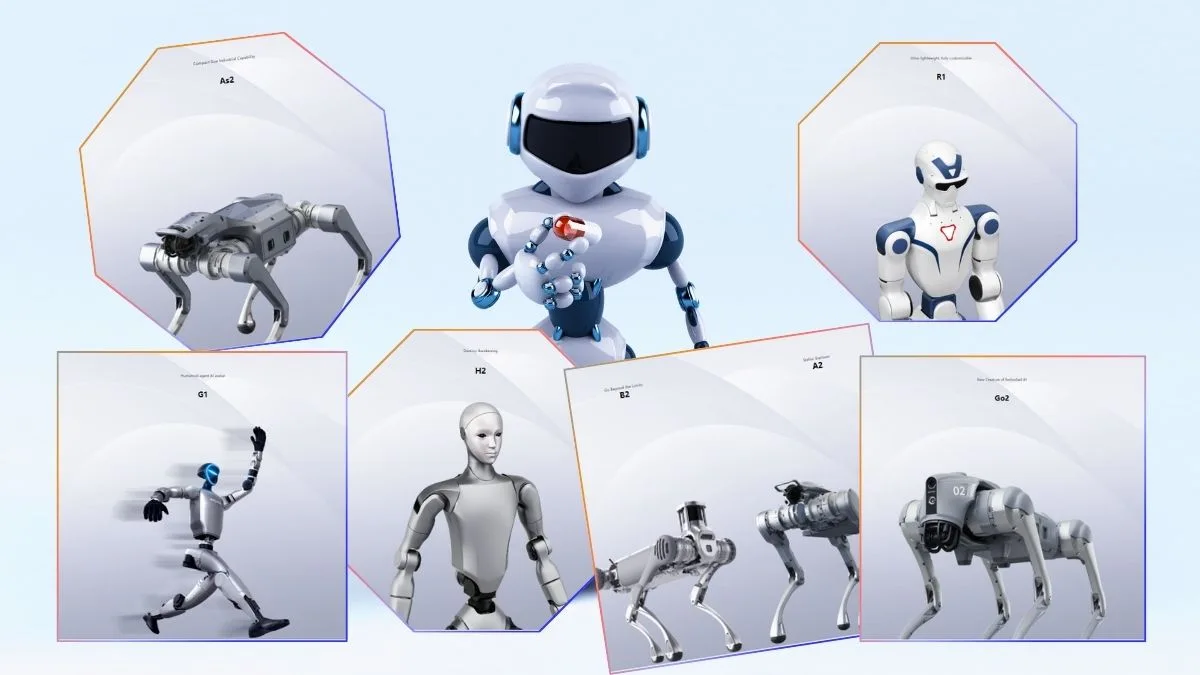
| G1 EDU | Humanoid (consumer/education) | ¥167,974 (~$26,000) | 18DoF, Intel i7, depth camera, LiDAR |
| H1 Standard | Humanoid (research) | ¥650,000 (~$100,000) | 48DoF, dual Jetson AGX Orin, millimeter-wave radar |
The G1, which retailed for about $13,500 at CES 2026 , has seen price adjustments based on configuration. The H1, standing 180cm and weighing 70kg, was showcased at CES 2026 as the latest evolution of Unitree’s humanoid line . At the company’s booth, two G1 robots wearing boxing gloves threw punches and kicks at each other, evoking the image of mixed martial arts fighters .
For startups, the Go2 Air at $1,600 is the entry point. You can buy one, integrate your AI models, test your applications, and scale to the H1 when you need full humanoid capability.
The Open Source Robotics China Ecosystem: How Huanxin Accelerates Development
The open source robotics China ecosystem is not just about free models. It is about speed.
Xin Xingguan, head of the China Capital Market Research Institute, put it bluntly at a recent conference in Seoul: “Through an open-source strategy, China has shortened the 10-year development timeline for AI humanoid robots to one year and is expected to usher in an era of mass-producing 100,000 humanoid robot units this year” .
The numbers support this claim. Omdia data shows that of the 13,318 humanoid units shipped globally last year, Chinese companies produced 87% . Agibot shipped 5,168 units, Unitree 4,200, Leju 500, Fourier 300 . By contrast, US companies like Tesla and Figure AI shipped around 150 each .
What enables this scale? Two things: supply chain and data.
The supply chain: China has nearly 10,000 robot-related companies, including 160 humanoid manufacturers and 600 core component suppliers . Most are startups less than 10 years old, yet they are producing batches of 5,000 to 6,000 units with ease . One parts supplier in Shenzhen told a visiting reporter: “Delivery of robot parts is completed in the time it takes to eat a bowl of noodles” .
The data: China has established seven nationwide “humanoid robot data factories” where about 100 robots collect real-world motion data daily . This data feeds the Huanxin AI models, improving their physical understanding and task execution.
How to Access Huanxin AI Models: A Practical Guide for Startups
If you are an AI founder, the how to access Huanxin AI models question is critical. The platform is open. Registration is free. The compute cards are allocated on a first-come, first-served basis.
What you get:
- Pre-trained embodied AI models for vision, language, and action
- Cross-ontology models that work across different robot hardware
- Training datasets covering real-world robot interactions
- Computing infrastructure with 2,200 domestic AI cards
This is not theoretical. Xiaoxiao Robotics recently open-sourced its Kairos 3.0-4B “embodied native world model,” which embeds physical causality into the model architecture . The model achieves real-time inference on edge devices and can generate 7-minute continuous video sequences of robots performing household tasks – pouring milk, opening drawers, transferring laundry – with consistent physics and no breaks .
The performance numbers are striking: Kairos 3.0-4B generates a 10-second task in 9.5 seconds of compute – 72 times faster than comparable models . It runs on NVIDIA, Moore Threads, Hygon, and other GPUs, consuming only 23.5GB of memory .
For founders, this means you can deploy embodied AI on edge devices without building a massive cloud infrastructure. The models are already optimized.
Unitree Humanoid Robots: Specifications and Lead Times
If you are evaluating Unitree humanoid robots for your startup, here is the current availability based on March 2026 information.
The Unitree H1 humanoid specifications are now well-documented. Standing 180cm tall and weighing 70kg, the H1 is designed for research applications . It features:
- 48 degrees of freedom
- Dual NVIDIA Jetson AGX Orin processors
- Millimeter-wave radar and stereo vision fusion for positioning
- Full torque sensor network for precise control
Shipping for the H1 began in April 2026, with lead times of 6–8 weeks for standard configurations . The Unitree H1 humanoid is priced at ¥650,000 for the standard research edition, with custom configurations available for academic and government labs .
For smaller deployments, the G1 EDU at ¥167,974 ($26,000) is a capable alternative. It supports ROS2 and Python development, includes 18 degrees of freedom, and features an Intel i7 processor with stereo depth cameras and LiDAR . The G1 was featured at CES 2026, where it demonstrated boxing and dancing capabilities, drawing consistent crowds .
The Unitree robot dog price for the Go2 Air starts at ¥10,314 ($1,600) . The Go2 series includes AI edge inference capabilities, supports Scratch and Python programming, and is suitable for education, inspection, and research applications.
The Domestic Robotics Ecosystem: Why 10,000 Companies Matter
The domestic robotics ecosystem in China is unlike anything in the US or Europe. It is not just about Unitree. It is about the density of suppliers, the speed of iteration, and the alignment of government policy.
Consider the numbers:
- 160 humanoid manufacturers
- 600 core component suppliers
- 10,000 total robot-related companies
- 30 billion yuan ($6.38 trillion won) invested in 2025
- 100,000 unit production target for 2026
This is not a market. It is an industrial mobilization. The Chinese government has drawn up a blueprint to fully introduce robots to 1,000 industries and 100 sub-sectors by 2028 .
For AI founders, this means your competitors are not just Unitree. They are thousands of startups, all building on the same open-source platform, all accessing the same free models, all racing to deploy.
The question is not whether you can compete. It is whether you can afford to build alone.
What the 87% Global Market Share Actually Means
The headline number – Chinese companies accounted for 87% of global humanoid robot shipments in 2025 – is impressive . But the underlying story is more important.
First, the scale is accelerating. Morgan Stanley projects China’s humanoid output at 28,000 units this year . The Gaogong Industry Institute of Robotics projects 65,000 . Industry insiders are discussing the possibility of mass-producing 100,000 units . That is a 7x to 20x increase from 2025 levels.
Second, the cost advantage is structural. While Tesla targets a $20,000 unit cost, China is already pushing into the market with robots in the $1,000 range . This is not subsidy. It is supply chain efficiency built over decades.
Third, the open source robotics platform strategy is accelerating innovation. As Xin Xingguan noted, China’s open-source approach has shortened the development timeline from 10 years to one year . This is how you go from 4,200 units shipped in 2025 to a potential 100,000 in 2026.
The Strategic Question for AI Founders
If you are building an AI robotics startup outside China, you have a choice.
You can ignore the Huanxin Community open source platform and build everything from scratch. You can raise $50 million to train your own models. You can spend 18 months sourcing components from fragmented suppliers. You can launch a prototype at $100,000 and hope to scale.
Or you can engage with the ecosystem that already exists.
The SASAC robotics platform is open. The Huanxin AI models are free. The Unitree humanoid robots are available for delivery. The domestic robotics ecosystem is waiting for developers.
You do not need to move to China to access it. But you do need to understand that the infrastructure for building AI robots is now concentrated in one place. And that place is not Silicon Valley.
My Research at
- China accelerates humanoid rollout, targets 100,000 units with open-source push – Chosunbiz, March 5, 2026
- China’s central SOEs launch embodied intelligence consortium – CGTN, February 12, 2026
- Humanoid robots from China, Germany, Korea compete at CES to assist humans – Chosunbiz, January 8, 2026
- IDC forecasts 85% global market share for Chinese robotics firms in 2026 – IDC via Securities Star, January 15, 2026
- Daxiao Robotics open-sources Kairos 3.0-4B embodied world model – China News Service, March 14, 2026
- China’s humanoid robot sector surpasses 160 firms as industry eyes mass market – abit.ee, March 2026
- Unitree robotics price list and specifications 2026 – php.cn, February 19, 2026
- IDC: Chinese service and consumer robotics firms to exceed 85% of global shipments in 2026 – Investing.com, January 15, 2026
- Daxiao Robotics open-sources embodied world model, enabling robots to work rather than just perform – Shanghai Observer, March 14, 2026
- Is Europe losing the robotics race to China? – Euronews, March 4, 2026