Zhongke Zhiyun China: The Physical AI Platform That Finally Cracks the “Mechanics Black Box” for Industrial Entrepreneurs
If you have ever tried to deploy a robot in a real factory, you know the feeling. The robot works perfectly in the lab. It picks, places, sorts, assembles with millimeter precision. Then you take it to the client’s floor. The lighting is different. The parts have a thin film of oil from the previous station. The conveyor belt shifts half a centimeter overnight. Your robot hesitates. The gripper slips. The part drops. The client calls. Your timeline slips. Your margins evaporate.
This is the mechanics black box—the single biggest barrier that has killed more industrial robotics startups than any other technical challenge. Traditional AI models are built to see patterns, not to understand physics. They can recognize a steel beam in a thousand images, but they do not know that steel has a density of 7,850 kilograms per cubic meter. They can identify a rubber gripper, but they do not know its friction coefficient. They can track a swinging load, but they cannot calculate its inertia.
For founders, CTOs, and researchers building the next generation of industrial automation, this gap between perception and physical understanding has been a nightmare. You spend months training models on thousands of examples. You simulate every possible scenario. And still, when conditions change, your AI guesses. And in heavy industry, a guess is a million‑dollar mistake.
In March 2026, Zhongke Zhiyun China released the first physical AI base designed specifically to solve this problem. Called the General Industrial Embodied Intelligence Base, it does not learn physics. It embeds physics. Gravity is not a pattern; it is a parameter. Friction is not a statistical observation; it is a mathematical constant. Inertia is not a guess; it is a calculation.
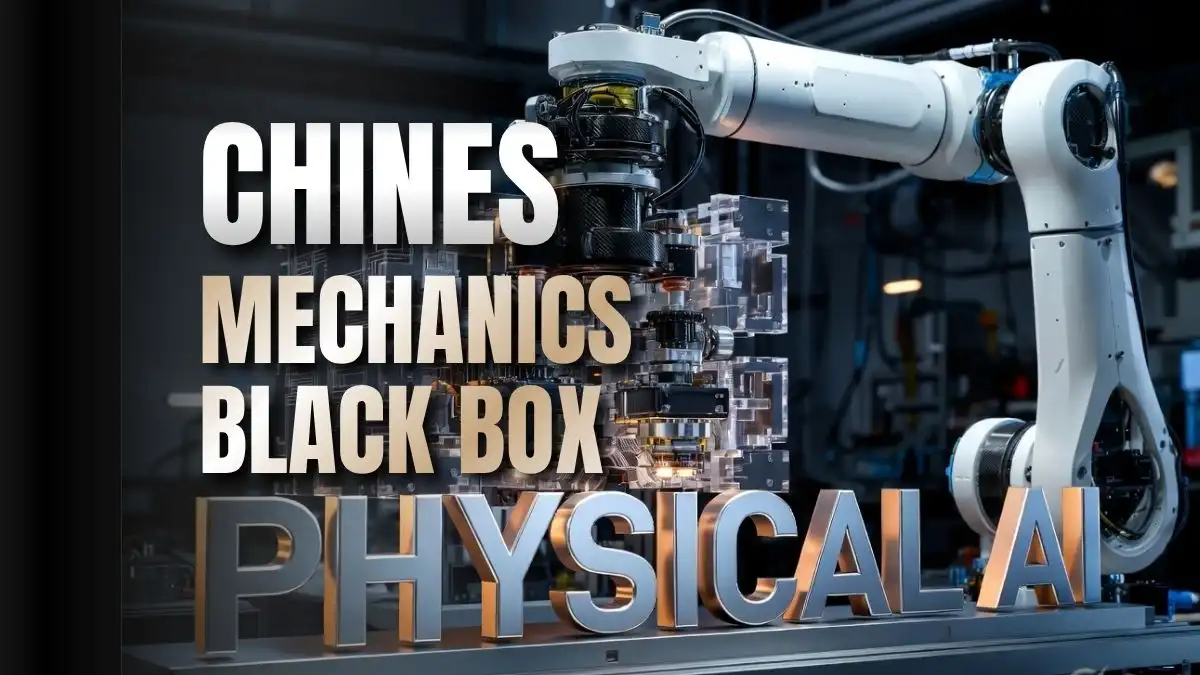
For you, the entrepreneur, this means you no longer need to train your robot on every possible variation of every task. You no longer need to retrain for every new client environment. You can finally build automation that works where traditional AI fails—on real factory floors, in ports, on construction sites, in heavy industry.
This is the platform that turns your robot from a spectator into a collaborator that truly understands the physical world.
The Mechanics Black Box That Has Been Killing Industrial Robotics Startups
Every robotics founder has a version of this story. You raise a seed round. You hire brilliant engineers. You build a prototype that wows investors. Then you land your first pilot with a manufacturer. And that is where the dream meets reality.
The manufacturer’s floor has dust. The lighting is fluorescent and flickering. The parts come with oil residue. The pallets are not perfectly aligned. Your robot, trained on clean data in a controlled lab, starts making mistakes. It misidentifies objects. It miscalculates grip force. It drops parts. The manufacturer loses confidence. The pilot extends. The runway shortens.
This is the mechanics black box – the gap between what an AI sees and what it understands about the physical world. It is not a hardware problem. Your robot has the motors, the sensors, the actuators. It is a software problem. Your AI does not know physics.
Consider the difference between a human worker and a traditional AI. A human sees a greasy metal part. They instinctively know that their grip needs to be firmer, that the part might slide. They do not need to have seen 10,000 greasy parts to know this. They understand friction. They understand that a lubricated surface reduces grip. They understand physics.
A traditional AI has no such understanding. It only knows patterns. If it has never seen a greasy part in its training data, it will treat the part as if it were dry. It will slip. It will drop. And you will explain to your client why the robot needs another three months of training.
Zhongke Zhiyun China looked at this problem and asked a different question: what if we stop teaching AI about physics and start building physics into AI?
The Architecture That Finally Embeds Physics into AI
The Zhongke Zhiyun platform is called the General Industrial Embodied Intelligence Base. The name is technical, but the concept is simple: instead of training models to approximate physical interactions, the platform embeds the laws of physics directly into the model weights.
What does that mean in practice? It means the AI does not need to learn that objects fall. It is built with gravity as a constant. It does not need to learn that rubber grips better than steel. It is built with friction coefficients embedded. It does not need to learn that a heavy load swings more. It is built with inertia calculations that happen automatically.
The architecture integrates four layers into a single, unified system that your engineering team can deploy today.
Perception builds real‑time 3D dynamic semantic maps that include material properties. When your robot looks at a steel beam, it does not just see a shape. It knows the beam’s density, its surface friction coefficient, its structural rigidity. This information is not learned from pixels. It is drawn from an embedded physical database. The platform eliminates visual blind spots entirely because it knows where blind spots happen—a capability that traditional computer vision systems lack.
Cognition processes natural language as physics. Your client says “move the heavy pallet carefully.” The system parses “heavy” as a mass constraint and “carefully” as a velocity constraint. The words are not abstract tokens; they are parameters in a physical equation. This means your robot can understand instructions the way a human operator would, without needing explicit programming for every scenario.
Execution generates movements that are mathematically guaranteed to respect physical limits. The AI does not calculate torque and then check if it is safe. It only generates torque values that are safe from the start. There is no correction loop. There is no “oops” moment. The physics are baked into every action.
Evolution trains in simulated environments that obey the same physical laws as the real world. Through Sim2Real (simulation to reality) technology, the AI undergoes millions of trial‑and‑error training cycles before touching a single physical object. When your robot moves from simulation to the factory floor, there is no adaptation gap. The physics are identical because they were identical from the start.
For you, the CTO, this means faster deployment. For you, the founder, this means lower R&D costs. For you, the researcher, this means a platform that actually works outside the lab.
The Physics That Are Now in the Model Weights
Three physical concepts have always been the Achilles’ heel of industrial AI. Zhongke Zhiyun China has embedded them into the platform’s core.
Gravity is no longer a pattern your robot has to learn from examples. It is a fixed constant in every calculation. Your robot knows that a 50‑kilogram load requires 50 kilograms of upward force to lift, adjusted for lever arms and angles. It does not guess. It knows.
Friction is no longer approximated from visual texture. Your robot knows that a steel beam on a rubber gripper has a friction coefficient of approximately 0.7. It knows that coefficient changes with lubrication, with surface finish, with contamination. It does not learn this. It is built with it.
Inertia is no longer a statistical guess. When your robot accelerates a load, it calculates the momentum. It knows the stopping distance. It knows the lateral forces. It knows that a sudden stop at the wrong angle will tip the load. It does not guess. It computes.
This is the breakthrough that industry observers call solving the mechanics black box. By embedding gravity friction inertia AI models directly into the platform’s core, Zhongke Zhiyun China has created the first physics-informed AI system that truly understands the physical world rather than approximating it.
For your business, this means your robot does not need to see a thousand examples of a part slipping to understand that oil reduces friction. It knows friction exists. It knows what friction is. And it knows how to calculate it. This is the difference between a prototype and a product that scales.
Where Entrepreneurs Are Already Deploying
According to China Industry News Network and Xinhua News Shanghai, Zhongke Zhiyun China has already deployed its platform across multiple industrial sectors. For entrepreneurs, these are the markets where the platform is already proven.
| Industry | What It Means for You |
|---|---|
| Port logistics | Autonomous cranes that calculate load inertia in real time, adjusting for wind and cable stretch without human intervention. If you are building port automation, this is your stack. |
| Construction | Material handling robots that navigate unstructured terrain, recalculating friction coefficients as surfaces change from concrete to mud. If you are targeting construction tech, the platform handles changing conditions that would break traditional automation. |
| Factory production | Flexible manufacturing cells that switch between products without reprogramming. If you sell to factories, your clients can reconfigure lines without calling you back for months of retraining. |
| Heavy equipment | Large‑scale machinery control with embedded safety limits that cannot be overridden. If you work in mining, energy, or infrastructure, your equipment can operate safely without constant human oversight. |
The common thread across these deployments is that the environments are not fixed. A construction site changes daily. A port faces variable weather. A factory reconfigures production lines for different products. Traditional automation fails in these environments because it relies on static patterns. Zhongke Zhiyun robots adapt because they understand the physics of what they are doing, not just the pattern of how it was done before.
For you, the entrepreneur, this means you can target markets that were previously too complex for automation. Your competitors who rely on traditional AI will still be trying to train their models on every possible scenario. You will be deploying.
The Market Opportunity for Industrial AI Founders
The industrial robotics market is projected to reach USD 1.83 billion by 2031, growing at a CAGR of 7.32%. But the real opportunity is not in hardware. It is in the software that makes hardware useful in complex environments.
Industry observers now call Zhongke Zhiyun in China is one of the “Industrial Embodied Intelligence Four Dragons,” alongside Zibianliang, Tongyong Yinhe, and Jijia Shijie. This designation reflects a consensus that the industrial AI market is consolidating around a few core technologies. If you are building on top of the right platform, you are positioned for scale.
The company’s focus on “fast and precise algorithms plus strong customization capabilities” is exactly what industrial clients demand. They do not buy general‑purpose AI. They buy solutions that work in their specific environments with their specific equipment. Zhongke Zhiyun’s physics‑embedded architecture allows you to customize without rebuilding the foundational physics model. That is your speed to market.
For investors, this is the kind of platform that creates an ecosystem. As more entrepreneurs build applications on top of Zhongke Zhiyun in China, the network effects grow. The platform accumulates more physical world data. The models get better. The moat widens. This is why the company has attracted attention from strategic investors and why it is positioned to lead the Chinese industrial AI platform landscape.
What This Means for Your Next Pilot
Let us bring this back to your specific problem. You have a pilot with a manufacturer. They make heavy equipment parts. The parts come off the line with variable coatings. Sometimes they are dry. Sometimes they are oiled. Sometimes they are dusty. Your traditional AI would require training on thousands of examples of each condition. That would take months. That would cost a fortune. That might still fail when a new coating appears.
With Zhongke Zhiyun China, you do not need to train for each condition. Your robot understands friction. It knows that oil reduces friction. It knows that dust increases friction. It calculates the appropriate grip force in real time based on what it sees and what it knows about material properties. The first time it encounters a new coating, it does not fail. It computes.
This is the difference between a pilot that drags on for six months and a pilot that turns into a purchase order in six weeks.
For your engineering team, this means less time spent curating datasets and more time building features that differentiate you from competitors. For your sales team, this means you can promise clients that your robot will work in their environment, not just in the lab. For your investors, this means a path to scale that does not require retraining the model for every new customer.
The Road Ahead: From Pilot to Scale
Zhongke Zhiyun China has laid out a technical roadmap that aligns with your growth ambitions. The platform is currently at Base 2.0, which is deployed in live industrial environments. Base 3.0, planned for 2028, will fuse SLAM, VLA (Vision‑Language‑Action), and Physical AI into a single unified model. The company calls this the “industrial metaverse”—a simulation environment where millions of random industrial scenarios can be generated and tested, driving generalization capabilities to levels that current systems cannot achieve.
For you, the entrepreneur, this means the platform you build on today will become exponentially more capable over time. Your investment in learning the stack, building applications, and deploying pilots will compound. The physics‑embedded foundation means you do not have to rebuild every time a new version is released.
In Pinky Words? The Mechanics Black Box Is Now Open
If you have been building industrial robotics, automation, or heavy equipment systems, you know that the mechanics black box has been your biggest barrier. Every time you tried to deploy, physics defeated you. You spent months training models on edge cases. You simulated thousands of scenarios. And still, when the real world threw a variable you had not seen, your AI guessed wrong.
Zhongke Zhiyun China has now removed that barrier. The physical AI base gives you deterministic physics, not statistical approximations. The industrial embodied intelligence platform adapts to changing conditions because it understands the laws that govern those conditions.
You no longer need to train your robot on every possible scenario. You no longer need to retrain for every new client. You no longer need to accept that your AI will occasionally guess wrong and drop a part.
The platform is deployed. It is proven. And it is available for you to build on.
The question is no longer whether you can solve the mechanics black box. The question is what you will build now that it is solved.